Hafnium's USGS price jumped 285% to US$6,130/kg in 2023 as by-product supply lagged
Hafnium only comes from making nuclear-grade zirconium. Tight supply met rising aerospace and chip demand, and the 2023 price rose 3.9-fold; China's licensing and US tariffs kept spot markets tight into 2026.
For information only, not investment advice. AnalystBro accepts no responsibility for decisions made on it. Full disclaimer.
- USGS's hafnium price rose from US$1,590/kg in 2022 to US$6,130/kg in 2023, up 285.5%. →
- The USGS average eased to an estimated US$3,800/kg in 2025, still nearly 5× the 2021 level of US$781/kg. →
- Supply is about 70–75 t a year from four countries, per industry estimates quoted by Argus; USGS publishes no world figure. →
- US tariffs on Chinese hafnium reached about 79% by April 2025, while Chinese export licences slowed after September 2024. →
- Spot quotes diverge from USGS: SMM estimated about US$13,115/kg in April 2026. →
USGS hafnium price rose 3.9-fold in one year, from US$1,590/kg in 2022 to US$6,130/kg in 2023
USGS reports an annual average price for unwrought hafnium, sourced from Argus Media. It was US$781/kg in 2021 and US$1,590/kg in 2022. In 2023 it reached US$6,130/kg, a 285.5% rise in one year and the highest value in the series that starts in 1959 [1][2].
The price then eased. USGS gives US$4,560/kg for 2024 (down 25.6%) and an estimated US$3,800/kg for 2025 (down 16.7%) [2]. Even so, the 2025 estimate is almost five times the 2021 level.
In 2025 dollars the 2023 average was about US$6,482/kg. Before 2022 the real price had not exceeded about US$1,740/kg (1963) in the whole series [1]. The 2022–2023 move was a break from six decades of a quiet, contract-driven market.
A number to check: 6,130 or 6,200?
The MCS 2024 chapter gave a 2023 estimate of US$6,200/kg [3]. The MCS 2026 chapter revised it to US$6,130/kg [2]. Our data pages use the later figure.
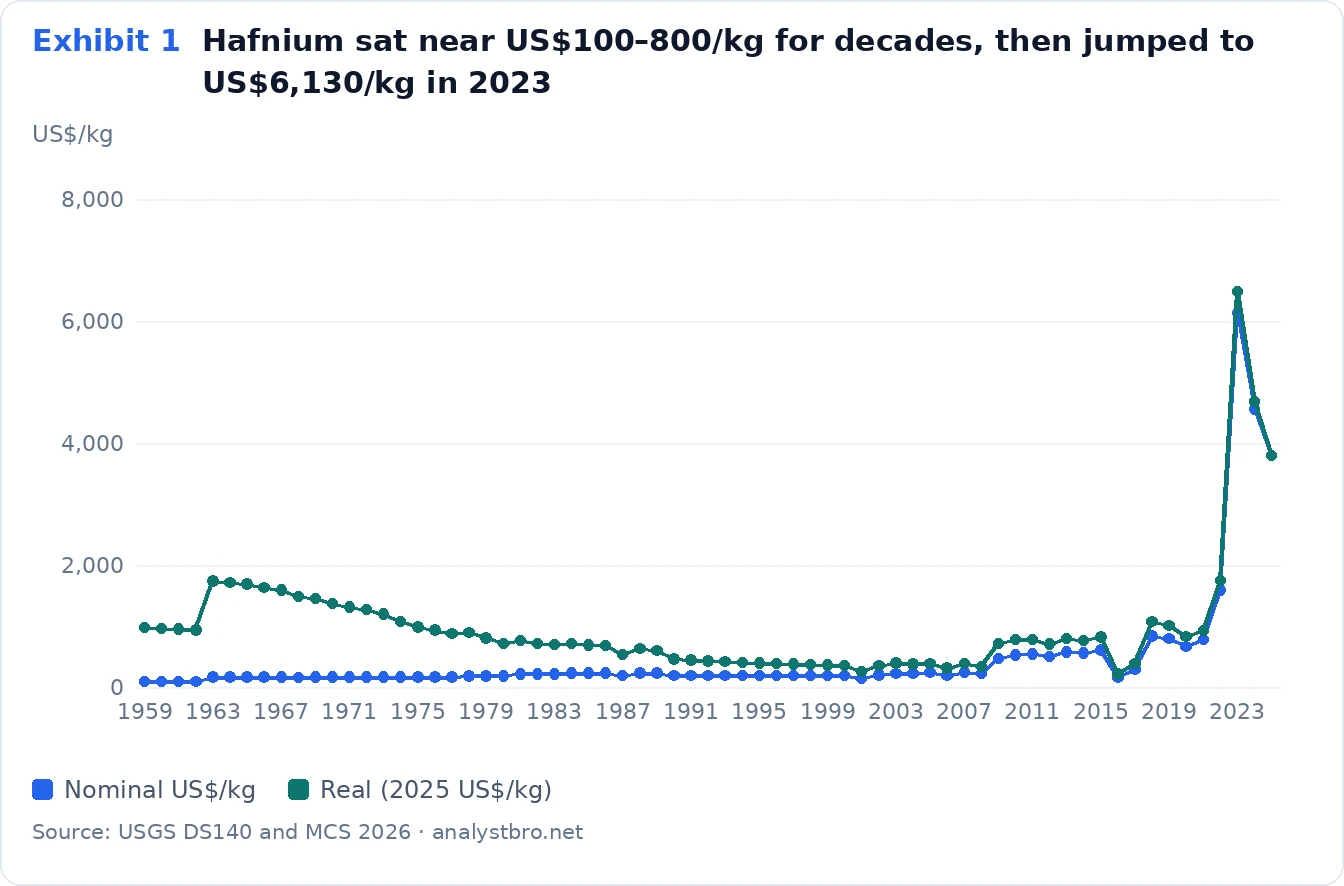
Hafnium jumped from US$1,590/kg in 2022 to US$6,130/kg in 2023, then eased to US$4,560/kg in 2024 and US$3,800/kg in 2025 (estimate).
Hafnium is a by-product of nuclear zirconium, so a demand jump cannot be met quickly
Hafnium has no mine of its own. It sits inside zircon, at about 1 part hafnium to 36 parts zirconium [3]. It is separated only when makers produce hafnium-free zirconium metal for nuclear use. USGS says hafnium metal is produced as a by-product of that process [3]. Output therefore follows nuclear zirconium orders, not the hafnium price.
USGS explained the 2023 spike this way: constrained supply met rising demand from aerospace alloys and electronics, which USGS called an unprecedented increase in prices [3].
USGS publishes no world hafnium production or reserve figures. Its 2026 chapter says these data "were not available" [2]. Industry estimates quoted by Argus put pure hafnium metal supply at about 70–75 t a year, from four countries: France, the US, China and Russia [4][5]. Argus sources called France the largest producer and said it had production problems in 2025 [5]. Western buyers have largely stopped using Russian hafnium since the war in Ukraine began [4]. USGS names China and Germany as the leading exporters of unwrought hafnium in 2025 [2].
- September 2024: China issued a dual-use export control list. Argus sources said hafnium licence approvals slowed afterwards, some licences were revoked, and exporters had to name the end user [4].
- February 2025: the US tariff on Chinese hafnium rose to 35% from 25%. After the 34% reciprocal tariff announced in early April 2025, the total stood at about 79%, as Argus reported on 4 April 2025. Hafnium was not exempted, unlike most non-ferrous metals [4].
- January 2025: China exported 1,499 kg of hafnium to the US, per Chinese customs; the US took none from China in February [4]. Argus reported later that China's exports to the US collapsed in April 2025 [5].
- October 2025: one trader told Argus it had had no export licence since October 2024 and another spoke of a "shadow ban", while a third said it got a licence in August [5]. We did not find a MOFCOM announcement naming hafnium; the restrictions reported are through licensing, not a published ban.
- SMM says China imposed export controls on hafnium from the second half of 2025 [6].
These events came after the USGS 2023 peak. They help explain why trade-press spot prices rose again in late 2025 and 2026 while the USGS annual average for 2025 was lower.
Superalloys are the leading use; chips and nuclear control rods are smaller but hard to replace
USGS states that the leading use of hafnium metal is superalloys [2]. Small hafnium additions strengthen nickel alloys in jet-engine and gas-turbine parts. Argus linked the October 2025 tightness partly to gas turbines: orders reached about 80 GW in 2024, against combined output capacity of about 30 GW at GE Vernova, Siemens Energy and Mitsubishi Heavy Industries [5].
In chips, hafnium dioxide is the high-k gate material in leading-edge logic and memory. SMM ties rising consumption to AI, high-performance computing, HBM and advanced DRAM [6]. Volumes used in wafer fabs are not published. We do not estimate a share for chips.
Nuclear reactors use hafnium in control rods because it absorbs neutrons. Argus reported in April 2025 that Japan and South Korea had increased purchases to support higher nuclear output [4].
USGS does not publish end-use shares for hafnium. Substitutes exist in places: boron or cadmium-silver-indium alloys can replace hafnium in control rods, and zirconium can be used in place of hafnium in some superalloys [2].
Hafnium is on the USGS final 2025 List of Critical Minerals, published on 7 November 2025 [7], and on the EU list of critical raw materials in Annex II of Regulation (EU) 2024/1252 [8].
New supply depends on zirconium metal capacity; USGS says hafnium recycling was minimal in 2025
Because hafnium comes from zirconium separation, more hafnium needs more hafnium-free zirconium production. Argus reported an industry consensus that supply must grow over the long term, while short-term prices depend on inventory levels [5]. SMM says alternative supply chains need long validation and build-out cycles [6].
Zircon itself is not scarce. USGS puts world zirconium mineral concentrate output at an estimated 1.2 million t in 2025 and reserves above 70 million t of ZrO2, led by Australia (55 million t) [2]. The constraint is separation capacity, not ore.
Recycling does little for now. USGS describes US hafnium metal recycling as minimal [2]. We found no sourced capacity figures for new hafnium separation plants, so we do not list projects here.
Bangladesh's link to hafnium is weak and indirect
Bangladesh does not refine or, as far as we can find, import meaningful amounts of hafnium metal. Its exposure is indirect: through imported chips, phones, computers and power-plant gas turbines that contain hafnium-bearing parts. Hafnium is a tiny share of the cost of such goods. We found no Bangladesh trade data for HS 8112.31 and do not estimate any.
The USGS figure is an annual average; 2026 spot quotes of US$13,000/kg are not the same measure
Our series is USGS's "Hafnium, unwrought, dollars per kilogram" [1]. From MCS 2026 its source is Argus Media's Argus Non-Ferrous Markets, as an annual average [2]. The 2025 value is a USGS estimate and may be revised, as the 2023 figure was (US$6,200 → US$6,130/kg) [2][3].
Spot quotes move faster and can differ a lot. Argus assessed Rotterdam duty-unpaid hafnium at US$3,700–3,900/kg in early April 2025 and US$5,100–5,800/kg on 7 October 2025, then the highest since December 2023 [4][5]. In April 2025 some long-term contracts signed in the crunch were near US$6,000/kg or more [4]. SMM's own estimate put overseas prices at about US$13,115/kg by April 2026, after holding near US$5,000/kg from May 2024 to October 2025 [6]. These are attributed quotes, not USGS data.
An annual average smooths short spikes. A year with a late rally, like 2025, can show a lower average than the year before. Live data: hafnium price, price history, profile and production by country. USGS gives no country production for hafnium, so that page shows zirconium context only.
FAQ
- What is the hafnium price per kg in 2025?
- USGS estimates the 2025 annual average for unwrought hafnium at US$3,800/kg, down from US$4,560/kg in 2024 [2]. Spot quotes were higher by late 2025: Argus assessed US$5,100–5,800/kg in Rotterdam in October 2025 [5].
- Why is hafnium so expensive?
- It is only produced as a by-product of hafnium-free nuclear zirconium, about 70–75 t a year from four countries, per industry estimates [3][4]. Demand from superalloys and chips rose faster than this supply [3].
- Who controls hafnium supply?
- France, the US, China and Russia produce pure hafnium metal, with France the largest per Argus sources [4][5]. China and Germany were the leading exporters of unwrought hafnium in 2025 [2].
- Has China banned hafnium exports?
- We found no published MOFCOM ban. Traders told Argus that licences slowed after China's September 2024 dual-use list, with one describing a "shadow ban" [4][5]. SMM says controls applied from the second half of 2025 [6].
- What is hafnium used in?
- Superalloys for jet engines and gas turbines are the leading use [2]. It is also used as hafnium oxide in chip gates and in nuclear control rods [4][6].
- Where can I get a free hafnium price history?
- Our price history page has the USGS annual series from 1959, nominal and in 2025 dollars [1].
Sources
- AnalystBro USGS annual hafnium series (DS140 1959–2021 spliced with MCS 2026) · link · accessed 2026-11-12
- USGS Mineral Commodity Summaries 2026 — Zirconium and Hafnium · link · accessed 2026-11-12
- USGS Mineral Commodity Summaries 2024 — Zirconium and Hafnium · link · accessed 2026-11-12
- Argus Media, 'Fresh concerns over the US 80pc tariff on hafnium' (4 April 2025) · link · accessed 2026-11-12
- Argus Media, 'Hafnium approaches two-year high on fresh demand' (8 October 2025) · link · accessed 2026-11-12
- SMM, 'From stability to surge: the overseas hafnium market caught between AI demand and supply controls' (4 June 2026) · link · accessed 2026-11-12
- Congressional Research Service, 'U.S. Geological Survey's Critical Minerals List' (IF13145, 7 January 2026) · link · accessed 2026-11-12
- Regulation (EU) 2024/1252 (Critical Raw Materials Act), Annex II · link · accessed 2026-11-12
Revision history
- 12-Nov-2026: Summarised raw event/data tables; added chart findings (this version)
- 12-Nov-2026
Disclaimer
This article is published by AnalystBro for information and education only. It is not investment, financial, legal or tax advice, not an offer or solicitation to buy or sell any security, and not a recommendation. It is based on company filings, official statistics and the sources cited, and was independently reviewed before publishing; it may still contain errors or omissions, and the data and estimates can be out of date. Fair values, forecasts and the model are estimates under stated assumptions, not predictions; past results don't indicate future returns.
AnalystBro, its owners and staff accept no responsibility or liability for any loss or damage arising from the use of, or reliance on, this article, its model or its data. Do your own research and consult a licensed adviser before making investment decisions. Any changes you make in the spreadsheet view stay in your browser and are your own.