Hafnium profile
USGS annual data · updated 2026-11-12 · next USGS release Jan–Feb 2027
Hafnium is a dense, corrosion-resistant metal that occurs together with zirconium in zircon sand.
Research
What is hafnium?
Hafnium is a dense, corrosion-resistant metal that occurs together with zirconium in zircon sand. It is separated as a by-product when nuclear-grade, hafnium-free zirconium is made.
On the US 2025 critical minerals list.
What is hafnium used for?
- Superalloys for jet engines and gas turbines
- Nuclear reactor control rods
- Hafnium oxide high-k gate dielectrics in advanced chips
- Plasma cutting electrodes
- Optical coatings
Who produces hafnium?
Output is small and comes from a handful of zirconium processors, mainly in France, the United States, China and Russia.
Supply risks
Supply depends entirely on demand for nuclear-grade zirconium, so it cannot be expanded independently. A few processors account for nearly all supply, and aerospace and chip demand compete for it.
Hafnium price history in brief
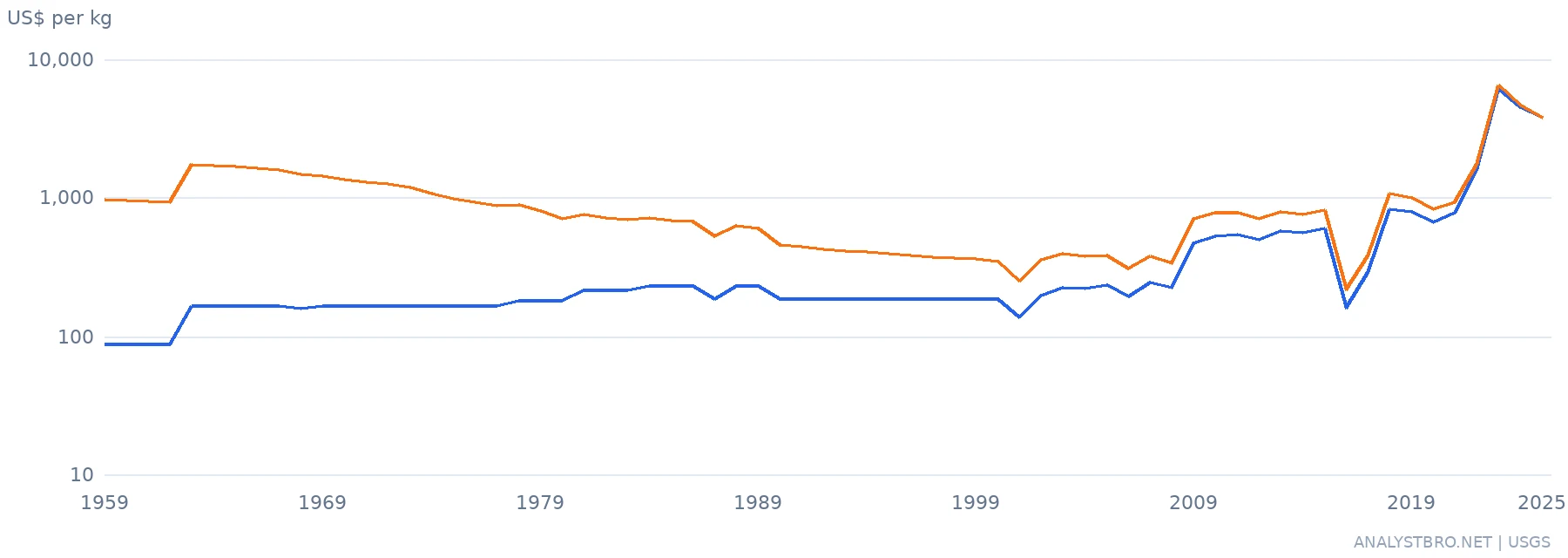
The USGS price for unwrought hafnium was $187 per kg in 2000 and peaked at $6,130 per kg in 2023. It fell to $4,560 in 2024, and the 2025 USGS estimate is $3,800 per kg, still about 20 times the 2000 level.
Why it matters for Bangladesh
Bangladesh has no hafnium industry; Hafnium is present in imported chips, aircraft engines and nuclear fuel components such as those used at Rooppur.
Frequently asked questions
What is the price of hafnium per kg?
The USGS estimate for 2025 is about $3,800 per kg, down from $4,560 in 2024 and the 2023 peak of $6,130.
Who produces hafnium?
A few zirconium processors, mainly in France, the US, China and Russia;
Is hafnium a critical mineral?
Yes, hafnium is on the US critical minerals list.
What is hafnium used for?
Superalloys, nuclear control rods, chip gate dielectrics and plasma cutting.
Why did hafnium prices fall in 2025?
After the 2023 spike, the USGS estimate fell from $4,560 to $3,800 per kg as aerospace demand pressure eased.
Related commodities
Zirconium · Tantalum · Niobium · Rhenium
- Source: U.S. Geological Survey, Mineral Commodity Summaries 2026 data release (doi:10.5066/P1WKQ63T) and Data Series 140, Historical Statistics for Mineral and Material Commodities (USGS). Public domain. 2025 values are USGS estimates (marked e).
- Facts only, not investment advice.