Rhenium profile
USGS annual data · updated 2026-11-12 · next USGS release Jan–Feb 2027
Rhenium is one of the rarest metals.
Research
What is rhenium?
Rhenium is one of the rarest metals. It is recovered as a by-product of molybdenum roasting, and the molybdenum itself mostly comes from porphyry copper ores.
On the US 2025 critical minerals list.
What is rhenium used for?
- Nickel superalloys for jet engine turbine blades
- Platinum-rhenium catalysts for petrol reforming
- Thermocouples
- Electrical contacts and filaments
Who produces rhenium?
In 2025 (USGS estimate) Chile produced 30,000 kilograms, about 37% of world mine production of 81,000 kilograms. Next came China (25%), Poland (12%). USGS puts world production at 81,000 kilograms in 2025. Chile holds about 52% of the reserves listed by USGS, followed by the United States (16%); Chile is also the largest producer.
Supply risks
Because rhenium comes only from molybdenum by-product streams, supply cannot be expanded independently. U.S. Net import reliance was 75% in 2025; Recycling of superalloy scrap and catalysts provides part of supply.
Rhenium price history in brief
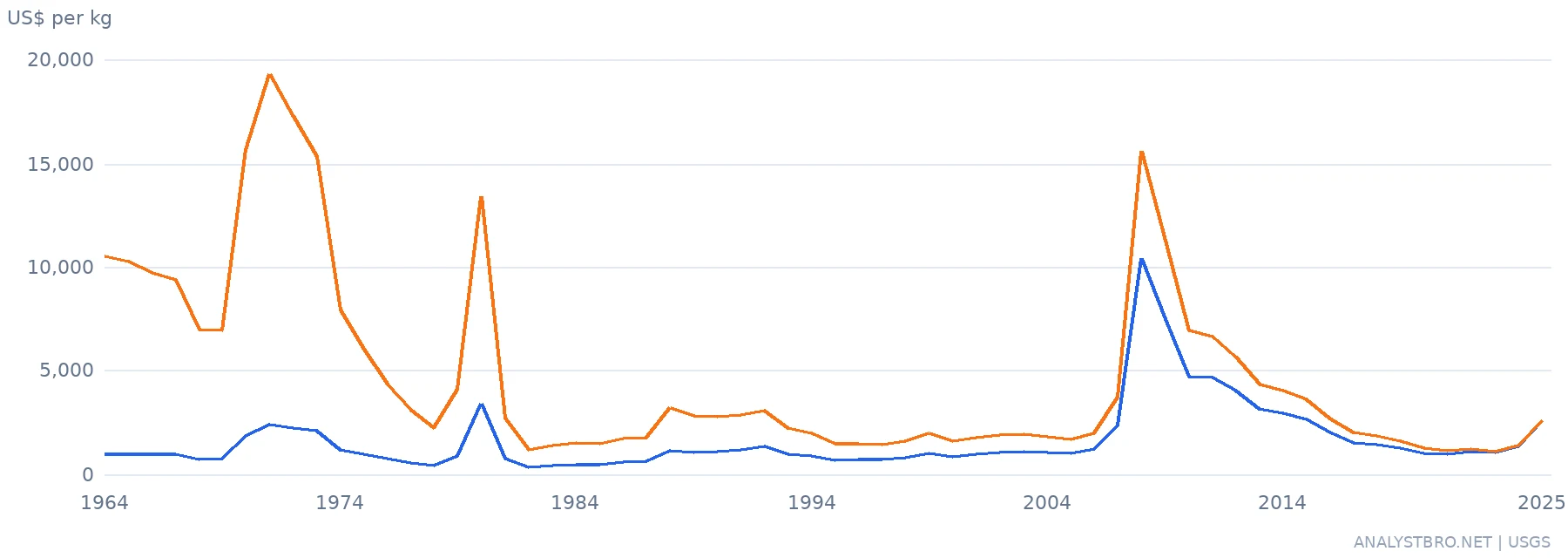
The USGS rhenium metal price series starts at $1,010 per kg in 1964 and peaked at $10,400 per kg in 2008. It was $1,360 in 2024, and the 2025 USGS estimate is $2,600 per kg.
Why it matters for Bangladesh
Bangladesh has no rhenium production; It appears only in imported aircraft engines and refinery catalysts.
Frequently asked questions
What is the price of rhenium per kg?
The USGS estimate for 2025 is $2,600 per kg of 99.99% metal.
Who is the largest producer of rhenium?
Chile: 30,000 kilograms in 2025, about 37% of world mine production (USGS estimate).
Is rhenium a critical mineral?
Yes. Rhenium is on the U.S. Critical minerals list.
What is rhenium used for?
Superalloys for jet engines and platinum-rhenium refining catalysts.
Related commodities
Molybdenum · Copper · Platinum · Nickel
- Source: U.S. Geological Survey, Mineral Commodity Summaries 2026 data release (doi:10.5066/P1WKQ63T) and Data Series 140, Historical Statistics for Mineral and Material Commodities (USGS). Public domain. 2025 values are USGS estimates (marked e).
- Facts only, not investment advice.