NdPr oxide fell 56% from its 2022 peak, but China's heavy rare-earth licences split prices
USGS data show NdPr oxide at US$124/kg in 2022, US$55/kg in 2024 and US$69/kg in 2025. Since April 2025, Chinese licences for dysprosium and terbium have opened a 4–5x gap between Chinese and European prices.
For information only, not investment advice. AnalystBro accepts no responsibility for decisions made on it. Full disclaimer.
- USGS NdPr oxide averaged US$124/kg in 2022, US$55/kg in 2024 and an estimated US$69/kg in 2025. →
- China mined 270,000 t of 390,000 t in 2025 and made 94% of sintered magnets in 2024. →
- Licensing of seven heavy rare earths from 4 April 2025 is still in force; the October 2025 add-ons are suspended to 10 January 2027. →
- Dysprosium oxide in Europe traded at about 4.9 times the China price in August 2026. →
- The US set a US$110/kg NdPr floor for MP Materials for 10 years, 59% above the 2025 USGS average. →
NdPr oxide fell from US$124/kg in 2022 to US$55/kg in 2024, then recovered to an estimated US$69/kg
The USGS tracks the price of neodymium-praseodymium (NdPr) oxide, 99% minimum, as the headline rare-earth price. NdPr is the main input to the permanent magnets in electric-vehicle motors, wind turbines and industrial robots. The annual average rose from US$92/kg in 2021 to a peak of US$124/kg in 2022 [1].
It then fell for two years: to US$75/kg in 2023 and US$55/kg in 2024 [1]. That is a 55.6% drop from the 2022 peak. In 2025 dollars the fall is larger in scale: US$136.5/kg in 2022 against US$56.5/kg in 2024 [1]. The USGS estimates the 2025 average at US$69/kg, up 25.5% on 2024, but still 44% below the 2022 peak [1].
The cheap light rare earths tell a different story. Mischmetal (65% cerium, 35% lanthanum) stayed between US$5.45/kg and US$6.52/kg over the same five years, with US$5.62/kg estimated for 2025 [1]. The money in rare earths sits in the magnet elements, not in cerium and lanthanum.
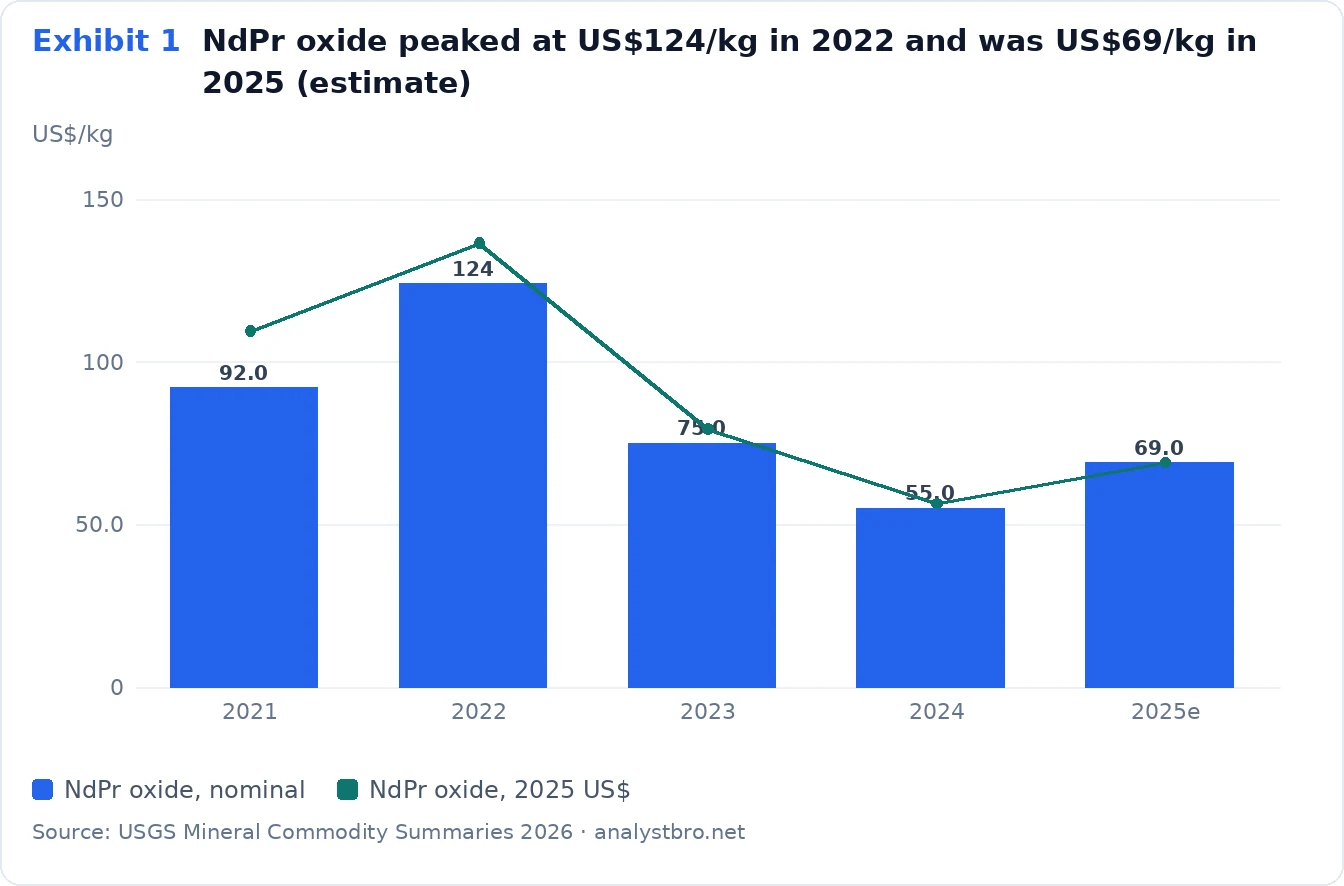
NdPr oxide averaged US$124/kg in 2022, fell to US$55/kg in 2024 and was an estimated US$69/kg in 2025.
| 2021 | 2022 | 2023 | 2024 | 2025e | |
|---|---|---|---|---|---|
| NdPr oxide, nominal (US$/kg) | 92 | 124 | 75 | 55 | 69 |
| NdPr oxide, 2025 US$ (US$/kg) | 109.4 | 136.5 | 79.3 | 56.5 | 69.0 |
| Mischmetal, nominal (US$/kg) | 5.66 | 6.52 | 5.47 | 5.45 | 5.62 |
The USGS series covers only 2021–2025. Longer history for a general rare-earth price line is on our price history page [2].
China mined 69% of 2025 output and controls 91% of refining, so its policy sets the market
Supply is concentrated. The USGS puts 2025 world mine output at 390,000 t of rare-earth oxide equivalent. China produced 270,000 t, or 69%. The United States produced 51,000 t, Australia 29,000 t and Burma 22,000 t [1]. Burma's output fell from 27,000 t in 2024 [1].
Mining is the less concentrated step. The IEA says China held 91% of refined rare-earth output and 94% of sintered permanent magnet production in 2024 [6]. China's magnet share was about 50% in 2005 [6]. Much ore mined elsewhere is still separated in China.
| Mine production (t REO) | 2024 | 2025 |
|---|---|---|
| China | 270,000 | 270,000 |
| United States | 45,500 | 51,000 |
| Australia | 29,000 | 29,000 |
| Burma | 27,000 | 22,000 |
| Thailand | 2,100 | 4,800 |
| India | 2,900 | 2,900 |
| Madagascar | 1,400 | 2,700 |
| Russia | 2,600 | 2,600 |
| Brazil | 560 | 2,000 |
| Nigeria | 1,500 | 1,500 |
| Other countries | 1,000 | 550 |
| Vietnam | 300 | 150 |
| Malaysia | 140 | 110 |
| World total | 380,000 | 390,000 |
The 2022 peak and the fall. The USGS series shows the price path but not the cause of each move. Prices rose in 2021–2022 as magnet demand grew, then fell as supply caught up. The IEA notes magnet rare-earth demand doubled after 2015 [6]. Chinese mining quotas are no longer published openly, so we do not quote quota numbers here.
4 April 2025: heavy rare-earth licensing. China's Ministry of Commerce (MOFCOM) and the General Administration of Customs issued Announcement No. 18 of 2025 on 4 April 2025, effective at once [14]. It requires an export licence for seven medium and heavy rare earths: samarium, gadolinium, terbium, dysprosium, lutetium, scandium and yttrium. The list covers the metals, alloys, oxides and compounds of these elements [14]. The IEA says export volumes fell sharply in April and May 2025 [6].
9 October 2025: expansion. MOFCOM added holmium, erbium, thulium, europium and ytterbium, bringing 12 of 17 rare earths under control. It also set a rule for foreign-made magnets and sputtering targets with 0.1% or more Chinese-origin rare-earth content by value [4].
7 November 2025: suspension. After a US–China trade truce, MOFCOM suspended the October measures until 10 November 2026 [4]. The April list was not suspended [4][6].
9 November 2026: extension. One day before expiry, MOFCOM and Customs issued Announcement No. 58 of 2026. It keeps the October 2025 measures suspended from 11 November 2026 to 10 January 2027 [5]. The April 2025 licensing of dysprosium, terbium and the other five elements stays in force.
Two prices for one metal. Licensing split the heavy rare-earth market. On 27 August 2026 Fastmarkets assessed dysprosium oxide at US$1,250–1,675/kg in Rotterdam against US$270–330/kg FOB China, about 4.9 times. Terbium oxide was US$4,200–5,000/kg in Europe against US$1,180–1,270/kg in China, about 3.8 times [7].
Magnets take about 95% of rare-earth value, led by EV motors
Permanent magnets make up around 95% of rare-earth consumption by value, according to the IEA [6]. Neodymium-iron-boron (NdFeB) magnets use NdPr as the main ingredient. Small amounts of dysprosium and terbium are added so the magnet keeps its strength at the high temperatures found inside traction motors.
The IEA expects magnet rare-earth demand to grow by a third by 2030 under today's policies, and demand outside China to rise 50% by 2035, mainly from electric vehicles [6]. Wind turbines, industrial motors, robots, drones, electronics and defence systems use the same magnets. Per-car and per-robot gram figures vary widely between sources, so we do not quote one.
The 2025 controls showed how deep this dependence runs. On 4 June 2025 CLEPA, the European auto suppliers' association, said several production lines and plants had shut, and only about a quarter of hundreds of licence requests since April had been granted [9]. Ford stopped Explorer production at its Chicago plant for a week in May 2025 because of a rare-earth shortage [10]. The IEA estimates that full use of China's controls could put US$6.5 trillion a year of downstream production outside China at risk [6].
Ex-China capacity planned by 2035 covers only about 25% of refining demand
Reserves. The USGS lists China with 44 million t of reserves, Brazil 21 million t, Australia 6.3 million t, Russia 3.8 million t and Vietnam 3.5 million t [1]. Brazil's mine output rose from 560 t in 2024 to 2,000 t in 2025 [1].
United States. In July 2025 the US Department of Defense agreed a package with MP Materials, owner of the Mountain Pass mine. It sets a US$110/kg floor for NdPr for 10 years, paid as the gap to the market price. The DoD invested US$400 million in preferred equity and warrants, about 15% on an as-converted basis. It also committed to buy 7,000 t a year of magnets for 10 years, and lent US$150 million for heavy rare-earth separation [8]. MP plans to raise magnet capacity from about 1,000 t to 10,000 t a year [8]. The US floor is 59% above the USGS 2025 estimate of US$69/kg [1].
Malaysia. Lynas produced the first separated dysprosium oxide outside China at its Malaysian plant in May 2025 [11], and first terbium oxide in June 2025 [12]. On 29 October 2025 it announced a A$180 million Malaysian facility for more heavy rare earths, including samarium, gadolinium, yttrium and lutetium [13].
Scale of the gap. The IEA says existing and planned capacity outside China would cover about 50% of mining demand by 2035, but only 25% of refining and well below 20% of magnets. It puts the investment needed at about US$60 billion over the next decade [6].
Recycling and design. The IEA says recycling could cut primary supply needs by up to 35% by 2050 [6]. Today recycled volumes are small and poorly measured. Japan cut rare-earth demand to 30% below 2010 levels after China's 2010 export controls, through demand-side policy [6]. Magnet-free motor designs exist, but we found no sourced figure on how much of the EV fleet uses them.
Bangladesh buys rare earths inside finished goods, not as oxides
Bangladesh does not mine, refine or make magnets. Its exposure comes through imported finished goods that contain NdFeB magnets: electric motors for easy-bikes and e-rickshaws, energy-saving BLDC ceiling fans, wind and electronics parts. These sit in trade codes HS 8501 (motors) and HS 8505 (permanent magnets), which can be checked in UN Comtrade. We do not have verified Bangladesh import figures for these codes, so we give none.
The 2025 licensing listed heavy rare-earth metals, alloys, oxides and compounds [14]. Bangladesh does not make magnets, so the likely channel is cost: higher magnet prices outside China raise the price of non-Chinese motors and parts.
The USGS price is a yearly NdPr average, not today's quote
The USGS line is an annual average for NdPr oxide, 99% minimum, in US dollars per kilogram [1]. The 2025 value of US$69/kg is an estimate made before the year closed and may be revised [1]. It does not show monthly swings.
Since April 2025 there is no single world price for heavy rare earths. Chinese domestic, FOB China and European prices now differ by about five times for dysprosium at mid-range (4.9x on 27 August 2026) [7]. Daily prices are sold by agencies such as Fastmarkets, Argus, SMM and Asian Metal; we quote them only as reported in their free news.
The USGS shows US net import reliance at 100% every year from 2021 to 2025 [1]. That is true even with US mine output of 51,000 t in 2025 [1], because the figure covers rare-earth compounds and metals, and US concentrate has mostly been processed abroad.
Free data: rare earths overview, price history, profile and production by country [2].
FAQ
- What is the NdPr price per kg in 2025?
- The USGS estimates the 2025 average for NdPr oxide (99% minimum) at US$69/kg, up from US$55/kg in 2024 and down from US$124/kg in 2022 [1].
- What is the dysprosium price?
- On 27 August 2026 Fastmarkets assessed dysprosium oxide at US$270–330/kg FOB China and US$1,250–1,675/kg in Rotterdam [7].
- Why are rare earths so expensive outside China?
- Since 4 April 2025 China requires export licences for dysprosium, terbium and five other elements [14]. Scarce non-Chinese supply pushed European heavy rare-earth prices to 3.8–4.9 times Chinese prices [7].
- Who controls rare earth supply?
- China mined 69% of world output in 2025 [1] and held 91% of refining and 94% of magnet production in 2024 [6].
- Is China's rare earth export ban still in place?
- The April 2025 licensing stays in force. The October 2025 expansion is suspended until 10 January 2027 under Announcement No. 58 of 2026 [5].
- Why are rare earths used in EV motors?
- NdFeB magnets made with NdPr give strong, compact motors; dysprosium and terbium help them work at high heat. Magnets are about 95% of rare-earth demand by value [6].
Sources
- USGS annual price, production and reserves data for rare earths (Mineral Commodity Summaries 2026, as held in AnalystBro USGS dataset) · link · accessed 2026-11-12
- AnalystBro rare earths market page (USGS series) · link · accessed 2026-11-12
- China Briefing: China's rare earth export controls · link · accessed 2026-11-12
- SMM: China extends suspension of rare earth export controls until January 2027 (9 Nov 2026) · link · accessed 2026-11-12
- IEA, Rare earth elements report, executive summary · link · accessed 2026-11-12
- Fastmarkets: China's looming November export controls test rare earth refining, recycling ambitions (10 Sep 2026) · link · accessed 2026-11-12
- Payne Institute (Colorado School of Mines): Explainer on the MP Materials–Department of Defense partnership (30 Jul 2025) · link · accessed 2026-11-12
- CLEPA press release: China's export restrictions on rare earths disrupt European automotive supply chains (4 Jun 2025) · link · accessed 2026-11-12
- Claims Journal (Bloomberg): Ford struggles with supply of rare earth magnets, CEO says (13 Jun 2025) · link · accessed 2026-11-12
- Mining Weekly: Lynas begins first heavy rare earth output outside China (16 May 2025) · link · accessed 2026-11-12
- Mining Weekly: Lynas adds terbium oxide to heavy rare earths portfolio (18 Jun 2025) · link · accessed 2026-11-12
- Mining Weekly: Lynas announces A$180m new Malaysia heavy rare earths facility (29 Oct 2025) · link · accessed 2026-11-12
- Holland & Knight: China imposes export controls on medium and heavy rare earth materials (Apr 2025) · link · accessed 2026-11-12
Revision history
- 12-Nov-2026: Summarised raw event/data tables; added chart findings (this version)
- 12-Nov-2026
Disclaimer
This article is published by AnalystBro for information and education only. It is not investment, financial, legal or tax advice, not an offer or solicitation to buy or sell any security, and not a recommendation. It is based on company filings, official statistics and the sources cited, and was independently reviewed before publishing; it may still contain errors or omissions, and the data and estimates can be out of date. Fair values, forecasts and the model are estimates under stated assumptions, not predictions; past results don't indicate future returns.
AnalystBro, its owners and staff accept no responsibility or liability for any loss or damage arising from the use of, or reliance on, this article, its model or its data. Do your own research and consult a licensed adviser before making investment decisions. Any changes you make in the spreadsheet view stay in your browser and are your own.