Manganese ore fell 19% to an estimated US$4.50/mtu in 2025
The China CIF price for 44% ore hit its lowest annual level since at least 2017 as Australian supply returned. South Africa and Gabon mine 63% of the world's manganese.
For information only, not investment advice. AnalystBro accepts no responsibility for decisions made on it. Full disclaimer.
- USGS estimates the China CIF manganese ore price at US$4.50/mtu in 2025, down 18.6% from US$5.53. →
- South Africa (7.6 Mt) and Gabon (5.0 Mt) mined 63% of the world's 20 Mt of manganese in 2025. →
- GEMCO in Australia restarted exports on 19 May 2025 after Cyclone Megan stopped them in March 2024. →
- Steel takes about 90% of manganese; batteries took about 100,000 t in 2025, per Benchmark. →
China's CIF manganese ore price fell 19% to an estimated US$4.50/mtu in 2025
There is no free daily price for manganese ore. The quotes most traders use come from paid agencies. The best free annual series is the one the US Geological Survey (USGS) publishes each February. It is the average price of metallurgical-grade ore with 44% manganese, delivered to China (cost, insurance and freight, CIF), in US dollars per metric ton unit (mtu). USGS takes the number from CRU Group [1].
On that basis the price was US$5.27/mtu in 2021, US$5.97 in 2022, US$4.80 in 2023 and US$5.53 in 2024. USGS estimates US$4.50/mtu for 2025, down 18.6% on 2024 [1][2]. That is the lowest value in the series back to 2017. The high point was US$7.16/mtu in 2018 [2].
One mtu is 10 kg of contained manganese, so one tonne of 44% ore holds 44 mtu. At US$4.50/mtu, a tonne of 44% ore delivered to China works out at about US$198 (4.50 × 44). This is our arithmetic on the USGS figure, not a quoted price.
Prices kept falling into late 2025. USGS reports that by October 2025 the year-to-date average spot price for 44% ore in China was 22% below the 2024 average [1]. In inflation-adjusted terms (2025 dollars) the 2025 estimate is 51% below 2018 (US$9.19 in 2025 dollars) [2].
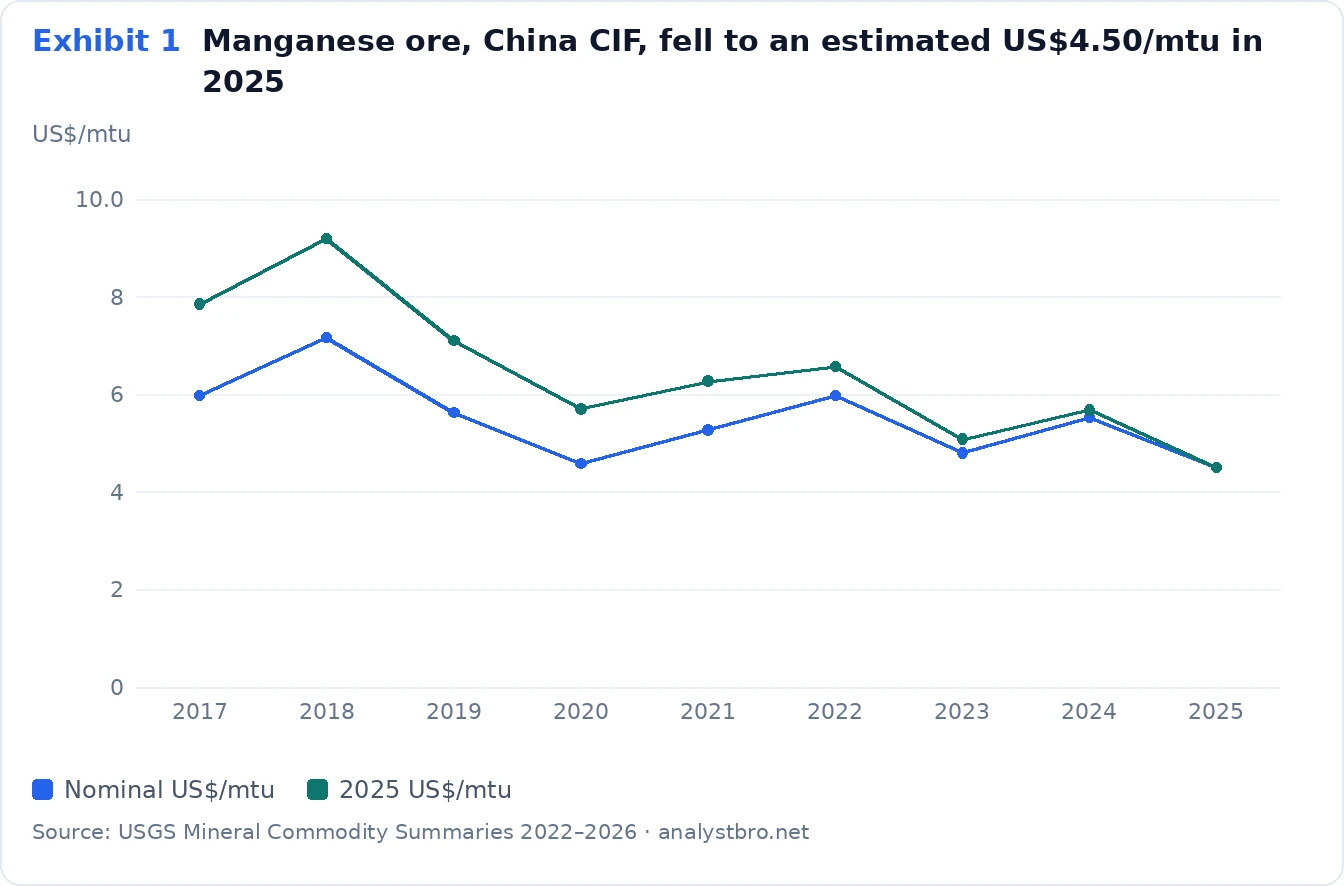
Manganese ore CIF China fell from US$5.53/mtu in 2024 to an estimated US$4.50/mtu in 2025, the lowest nominal level since 2017.
| 2017 | 2018 | 2019 | 2020 | 2021 | 2022 | 2023 | 2024 | 2025e | |
|---|---|---|---|---|---|---|---|---|---|
| Nominal (US$/mtu) | 5.97 | 7.16 | 5.63 | 4.58 | 5.27 | 5.97 | 4.80 | 5.53 | 4.50 |
| Real, 2025 US$/mtu | 7.85 | 9.19 | 7.10 | 5.70 | 6.27 | 6.57 | 5.08 | 5.68 | 4.50 |
| Per tonne of 44% ore (US$, derived) | 263 | 315 | 248 | 202 | 232 | 263 | 211 | 243 | 198 |
South Africa and Gabon mined 63% of the world's manganese in 2025
World mine production was an estimated 20 million tonnes of contained manganese in 2025, up from 18.7 million in 2024 [1][2]. Four countries lead. South Africa mined 7.6 million tonnes (38%), Gabon 5.0 million (25%), Ghana 2.0 million (10%) and Australia 1.6 million (8%) [1]. China mined only 0.7 million tonnes, about 3.5%, yet it is the main buyer of seaborne ore, which is why the benchmark is a China CIF price.
Ghana grew fastest. Its output rose from 1.28 million to 2.0 million tonnes, up 56%. USGS notes it made large revisions to 2024 numbers for Ghana and Australia using company and government reports [1].
| 2024 | 2025e | Share 2025 | |
|---|---|---|---|
| South Africa | 7,490 | 7,600 | 0 |
| Gabon | 4,640 | 5,000 | 0 |
| Ghana | 1,280 | 2,000 | 0 |
| Australia | 1,600 | 1,600 | 0 |
| Other countries | 1,240 | 1,300 | 0 |
| Brazil | 705 | 800 | 0 |
| India | 731 | 790 | 0 |
| China | 690 | 700 | 0 |
| Côte d'Ivoire | 340 | 350 | 0 |
| World total | 18,700 | 20,000 | 1 |
Reserves sit in a few places too. USGS lists Australia at 580 million tonnes and South Africa at 550 million tonnes of contained manganese, then Brazil 300 million and China 260 million [1]. USGS adds that South Africa holds about 70% of the world's land-based manganese resources [1].
Australia shows how one mine can move the market. Tropical Cyclone Megan hit Groote Eylandt in March 2024 and damaged the wharf and haul road of GEMCO, South32's manganese operation [3]. Exports stopped for more than a year. South32 resumed export sales on 19 May 2025 [3]. USGS also records that the northern Australian mine resumed in May 2025 [1].
Read together, the dates line up with the price series. The 2024 average rose to US$5.53/mtu while Australian supply was out, and the 2025 average fell to US$4.50 as Australian shipments came back and Ghana and Gabon raised output [1][2][3]. USGS does not state a cause for the price fall, so this is a timing match, not a measured effect.
About 90% of manganese goes into steel; batteries took about 100,000 t in 2025
Steel is the main use. Manganese removes oxygen and sulphur during steelmaking and adds strength and hardness. Benchmark Mineral Intelligence puts steel at about 90% of all manganese mined [4]. USGS says manganese use closely follows steel, and it has no satisfactory substitute in its major uses [1]. The World Steel Association expected global finished steel use in 2025 to be unchanged from 2024, according to USGS [1].
Most ore is first turned into alloys: ferromanganese and silicomanganese. The International Manganese Institute notes that China is by far the largest producer of manganese alloys, and that aluminium is the second most important use after steel [5].
Batteries are small but growing. Benchmark estimates battery uses took about 100,000 tonnes of manganese (metal equivalent) in 2025 [4]. That is about 0.5% of the 20 million tonnes mined [1]. Battery makers need high-purity manganese sulphate monohydrate (HPMSM), above 99.95% pure [4]. It goes into NCM (nickel-cobalt-manganese), LMO (lithium manganese oxide), LMNO and LMFP cathodes. In NCM cathodes manganese is roughly 10% to 60% of the metal content, depending on the mix [4]. Benchmark says China makes the majority of HPMSM [4].
Older uses remain. USGS lists animal feed, brick colorant, dry-cell batteries and fertilizers among non-metallurgical uses in the US [1].
| Metallurgical ore | Battery-grade (HPMSM) | |
|---|---|---|
| Typical grade | 35–54% Mn (USGS ref. 44%) | >99.95% purity |
| Main end use | Ferroalloys for steel | NCM, LMO, LMNO, LMFP cathodes |
| Volume, 2025 | 20 Mt Mn content mined | ~100,000 t Mn (Benchmark est.) |
| Free price | USGS annual, China CIF | None free |
The EU lists battery-grade manganese as a strategic raw material; the US relies 100% on imports
The European Union's Critical Raw Materials Act, Regulation (EU) 2024/1252 of 11 April 2024, lists "manganese — battery grade" in Annex I as a strategic raw material and "manganese" in Annex II as a critical raw material [6]. Strategic status gives listed projects faster permitting and access to support under the Act.
The United States has mined no manganese ore with 20% or more manganese since 1970 [1]. Its net import reliance has been 100% every year from 2021 to 2025 [1][2]. From 2021 to 2024 its ore came from Gabon (64%), South Africa (24%) and Mexico (12%) [1]. The US government stockpile listed 292,000 tonnes of metallurgical-grade ore as potential disposals in fiscal 2025 [1].
There is little substitution or recycling to fall back on. USGS says recycling of manganese is incidental, as part of steel and other scrap, and that scrap recovery aimed at manganese is negligible [1]. Manganese is also recovered with iron from steel slag [1].
New supply in recent years has come mostly from existing producing countries: Gabon and Ghana together added about 1.1 million tonnes of contained manganese in 2025 [1]. We did not find a free primary source with dated production figures for new high-purity manganese plants outside China, so we do not list project capacities here.
Bangladesh's link is through steel: 5.8 Mt of scrap bought from abroad in 2024
Bangladesh has no manganese mining, and our UN Comtrade dataset does not yet carry a manganese ore or ferroalloy series for Bangladesh, so we give no manganese import figure. The link is indirect, through steel. Bangladesh's steel mills melt imported scrap, and every tonne of steel needs manganese, usually as ferromanganese or silicomanganese.
Supplying countries reported exports of iron and steel scrap (HS 7204) to Bangladesh of 5.85 million tonnes worth US$1.60 billion in 2024, against 4.52 million tonnes and US$1.79 billion in 2023 [7]. These are partner-reported FOB values: Bangladesh has not reported to UN Comtrade since 2015, and the latest year may be incomplete. See our iron and steel scrap imports page.
The USGS figure is a CRU annual average for 44% ore in China, quoted per mtu
The USGS price basis is: "Price, average, manganese content, cost, insurance, and freight, China, dollars per metric ton unit" [1]. Footnote 5 of the chapter says it is for metallurgical-grade ore with 44% manganese and that the source is CRU Group [1].
- Unit. The price is per metric ton unit (1% of a tonne, 10 kg of manganese), not per tonne of ore. Multiply by the ore grade (44) for a per-tonne figure.
- Annual average. It smooths out monthly swings, so it will not match a single day's quote from an agency.
- Delivered to China. CIF includes freight and insurance; a South African or Gabonese FOB price is lower by the shipping cost.
- Estimates. The 2025 value is a USGS estimate made before year end and may be revised in the 2027 edition.
- Grades. Ore grades range from 35% to 54% manganese [1]; higher grades usually carry a premium per mtu, and battery sulphate is priced separately.
Our data pages carry the same series: manganese overview, price history, profile and production by country.
FAQ
- What is the manganese ore price in 2025?
- USGS estimates the 2025 average at US$4.50 per metric ton unit for 44% ore delivered to China (CIF), down from US$5.53 in 2024 [1]. That is about US$198 per tonne of 44% ore.
- What does US$ per mtu mean for manganese?
- A metric ton unit is 1% of a tonne, or 10 kg of contained manganese. Multiply the mtu price by the ore grade to get the price per tonne of ore: 4.50 × 44 = about US$198.
- Who produces the most manganese?
- South Africa, with an estimated 7.6 million tonnes of contained manganese in 2025 (38% of world output), followed by Gabon, Ghana and Australia [1].
- Why did manganese prices fall in 2025?
- USGS gives no single cause. In the same period, Australia's GEMCO restarted exports in May 2025 and output in Ghana and Gabon rose, while world steel use was flat [1][3].
- Where can I find a free manganese price?
- Daily and weekly prices are sold by agencies. The free annual series is in the USGS Mineral Commodity Summaries; we chart it on our price history page.
Sources
- USGS Mineral Commodity Summaries 2026: Manganese · link · accessed 2026-11-13
- AnalystBro USGS annual dataset (MCS 2022–2026), manganese · link · accessed 2026-11-13
- South32: Export sales resume at GEMCO (19 May 2025); Mining Magazine / SMM reports · link · accessed 2026-11-13
- Benchmark Mineral Intelligence: What is manganese? · link · accessed 2026-11-13
- International Manganese Institute: About manganese · link · accessed 2026-11-13
- Regulation (EU) 2024/1252 (Critical Raw Materials Act), Annexes I and II · link · accessed 2026-11-13
- UN Comtrade, partner-reported exports to Bangladesh, HS 7204 (AnalystBro bd_imports.json) · link · accessed 2026-11-13
Revision history
- 13-Nov-2026: Summarised raw event/data tables; added chart findings (this version)
- 13-Nov-2026
Disclaimer
This article is published by AnalystBro for information and education only. It is not investment, financial, legal or tax advice, not an offer or solicitation to buy or sell any security, and not a recommendation. It is based on company filings, official statistics and the sources cited, and was independently reviewed before publishing; it may still contain errors or omissions, and the data and estimates can be out of date. Fair values, forecasts and the model are estimates under stated assumptions, not predictions; past results don't indicate future returns.
AnalystBro, its owners and staff accept no responsibility or liability for any loss or damage arising from the use of, or reliance on, this article, its model or its data. Do your own research and consult a licensed adviser before making investment decisions. Any changes you make in the spreadsheet view stay in your browser and are your own.