Germanium's USGS price rose 3.5 times to US$4,100/kg as China cut exports
The 2025 USGS estimate is double 2024. China's germanium metal exports fell 60% in January–September 2025 after licensing and a US ban.
For information only, not investment advice. AnalystBro accepts no responsibility for decisions made on it. Full disclaimer.
- USGS estimates the 2025 germanium metal price at US$4,100/kg, 3.5 times 2021 and double 2024. →
- China's germanium metal exports fell to 7,520 kg in Jan–Sep 2025, from 36,656 kg in the same months of 2023. →
- China's 9-Nov-2025 suspension of its US export ban runs to 27-Nov-2026; licensing stays in force. →
- Fibre optics and infrared optics are the top US uses; Congo's Gécamines announced its first germanium concentrate shipment in October 2024. →
The USGS germanium metal price rose from US$1,187/kg in 2021 to an estimated US$4,100/kg in 2025
USGS puts the 2025 annual average price of germanium metal at US$4,100 per kg, an estimate [1][2]. That is 3.5 times the 2021 average of US$1,187/kg. It is also 106% above the 2024 average of US$1,991/kg [1]. Most of the rise came in the last two years: from 2021 to 2023 the price rose only 17%, to US$1,392/kg.
Germanium dioxide moved the same way. Its USGS annual average went from US$770/kg in 2021 to an estimated US$2,500/kg in 2025 [2]. In real terms (2025 dollars) the 2025 metal price is the highest since 1996 (about US$4,112/kg in 2025 dollars); within 2005–2024 the real peak was 2014 at about US$2,609/kg [1].
Within 2025 the climb was steep. USGS reports that the European price for 99.999% germanium metal rose from US$3,150/kg in January to US$5,380/kg in October [2]. The full series is on our price history page.
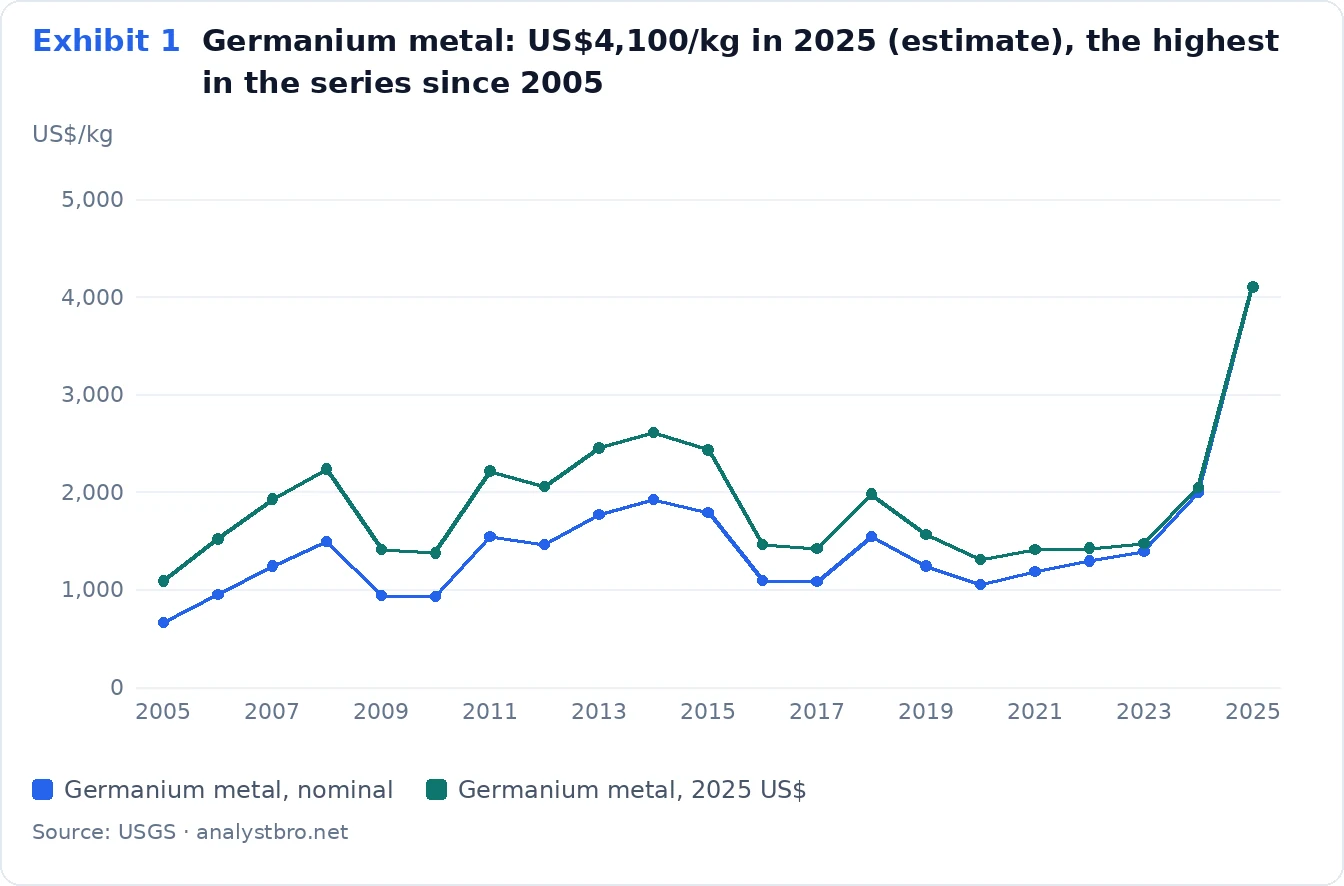
Germanium averaged US$4,100/kg in 2025 (USGS estimate), up from US$1,991/kg in 2024 and US$660/kg in 2005.
China cut germanium metal exports by 60% in the first nine months of 2025
China is the leading producer and exporter of germanium metal, USGS says [2]. Producers rarely report output, so USGS does not publish a country production table for germanium, and our data file has none [1][2]. USGS names only a few countries that process or recycle it commercially: the United States, Belgium, Canada, China, Germany and Russia [2].
Germanium is a by-product. It is recovered from certain zinc and lead-zinc-copper sulphide ores and from lignite coal [2]. Supply therefore follows zinc refining and coal, not germanium demand. In the US, a Tennessee mine that fed germanium-bearing zinc concentrate to the Clarksville smelter has been suspended since November 2023 [2].
Policy did the rest. The timeline:
- August 2023: China starts an export licensing programme for germanium [2].
- 3-Dec-2024: MOFCOM Announcement No. 46 of 2024 bans exports of gallium, germanium, antimony and superhard materials to the United States [3][2].
- 9-Nov-2025: MOFCOM Announcement No. 72 of 2025 suspends the US ban until 27-Nov-2026. Export licences are still required, and the ban on military end-users stays [3][4][5].
- 27-Nov-2026: the suspension is due to end. As of 12-Nov-2026 we found no announcement of an extension.
The trade data show the effect. China's reported germanium metal exports for January–September 2025 were 7,520 kg, against 18,787 kg in the same months of 2024 and 36,656 kg in 2023 [2]. That is a 60% fall in one year and 79% in two. In 2025 the exports went mostly to Russia (28%), Belgium (26%), Germany (26%) and Japan (18%) [2]. US imports of germanium metal fell an estimated 67% in 2025, to 7,000 kg [2].
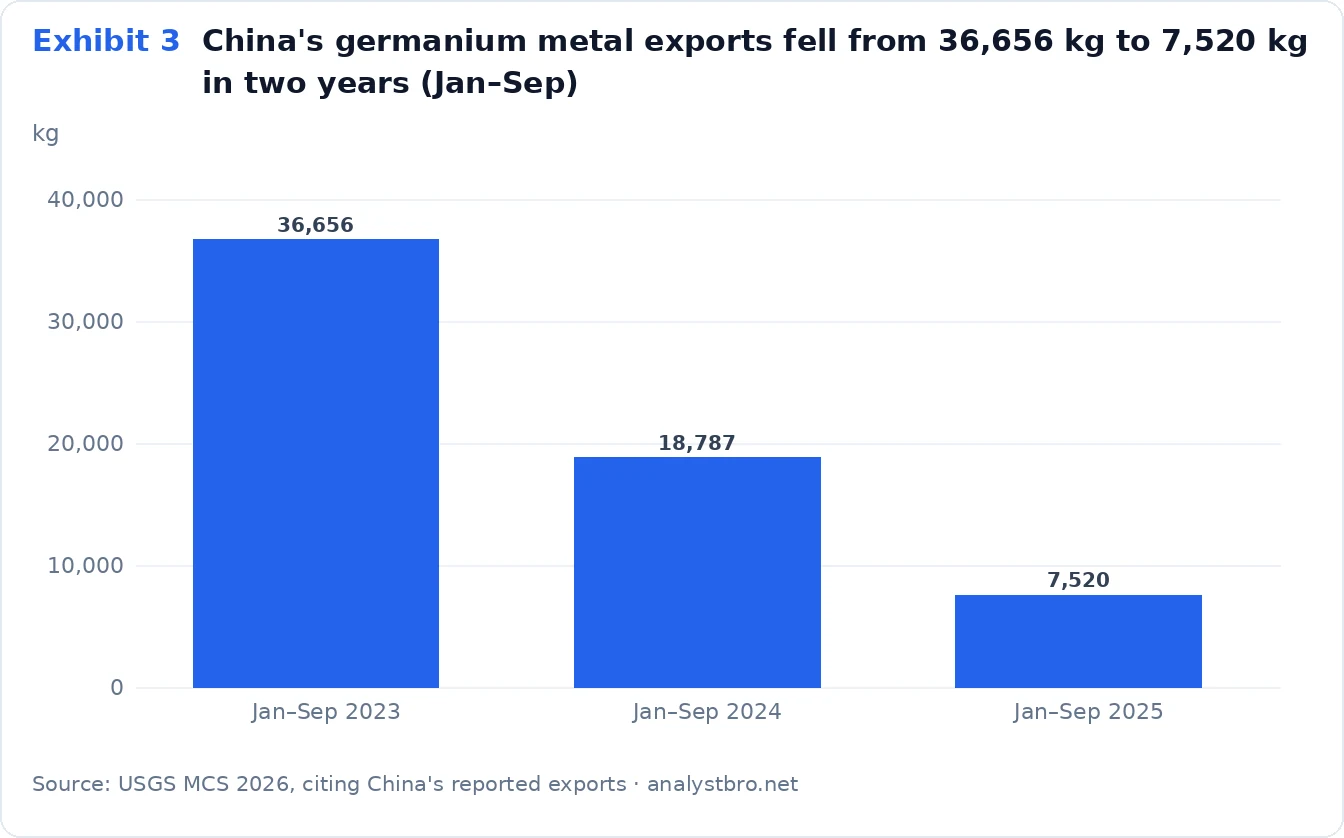
China's Jan–Sep germanium metal exports fell from 36,656 kg in 2023 to 18,787 kg in 2024 and 7,520 kg in 2025.
Fibre optics is the largest US use of germanium, ahead of infrared optics
USGS lists the main US end uses, in descending order: fibre optics, infrared optics, semiconductors and solar cells, and radiation detectors [2]. USGS does not give percentage shares, and global shares sit behind paid data.
- Fibre optics: germanium dioxide and tetrachloride go into optical-fibre glass for data and telecom networks [2].
- Infrared optics: germanium metal is made into lenses and windows for thermal imaging in commercial and military systems [2].
- Space solar cells: germanium wafers are the base for multijunction solar cells on satellites; a company in St. George, Utah, makes them [2].
- Detectors and chips: high-purity germanium radiation detectors, and germane gas for some semiconductor and solar-cell processes [2].
Germanium is also used as a polymerisation catalyst, where antimony and titanium can replace it [2].
Congo announced its first germanium concentrate shipment to Belgium in October 2024
In May 2024 Umicore signed a partnership with STL, a unit of Congo's state miner Gécamines, to recover germanium from the Big Hill tailings near Lubumbashi, with Umicore taking the output [6]. On 14-Oct-2024 Gécamines announced its first shipment of germanium concentrate to Umicore in Belgium; Umicore described the concentrates as due for export [7][8].
In North America, germanium-bearing zinc concentrate from an Alaska mine goes partly to a refinery in Canada, which recovers germanium as dioxide and tetrachloride [2]. In August 2025 the US Department of Energy announced US$1 billion of critical-mineral initiatives that include refining and by-product recovery of germanium [2]. USGS also lists germanium-rich deposits and tailings in development in China, Congo (Kinshasa), Russia and the US [2].
Recycling matters. Scrap from machining infrared optics, old military lenses, optical-fibre waste and used solar wafers are all recycled, but USGS has no reliable estimate of the tonnage [2]. Substitutes exist in parts: silicon or gallium arsenide in some electronics, and chalcogenide glass in infrared optics [2]. The US National Defense Stockpile listed potential disposals of 5,000 kg of germanium for FY2025 [2].
Bangladesh's link to germanium is indirect: through fibre-optic cable and imported equipment
Bangladesh does not produce germanium and we found no evidence of imports of the metal itself. The link is through finished goods: optical-fibre cable for telecom and internet networks, and thermal or infrared devices, all made abroad. Germanium is a small part of the cost of those products, so the price rise is unlikely to show up clearly in Bangladeshi import prices. We have no Bangladeshi data that isolates germanium, and we do not estimate one.
The USGS price is a yearly average for germanium metal; 2025 is an estimate
Our series is the USGS "annual average, dollars per kilogram: germanium metal" [1]. It is a whole-year average, so it lags spot moves. The 2025 figure of US$4,100/kg sits between the January and October European quotes cited by USGS (US$3,150 and US$5,380/kg) [2]. The 2025 value is marked as an estimate and USGS may revise it next year.
USGS says its price is the Argus Media average European price for 99.999% germanium metal [2]. Quotes from other agencies, such as Fastmarkets or SMM for China, can differ by grade, location and timing. For production and the commodity overview see our germanium page, profile and production by country pages. Gallium, controlled at the same time, is covered on our gallium page.
FAQ
- What is the germanium price per kg in 2025?
- USGS estimates the 2025 annual average for germanium metal at US$4,100 per kg, up from US$1,991/kg in 2024. European quotes cited by USGS reached US$5,380/kg in October 2025.
- Why is germanium so expensive?
- It is a by-product of zinc and coal, so supply cannot rise quickly, and China, the leading producer, has required export licences since August 2023 and banned US exports from December 2024. China's metal exports fell 60% in Jan–Sep 2025.
- Who controls germanium supply?
- China is the leading producer and exporter, says USGS. Belgium, Canada, Germany, Russia and the US also process or recycle it. USGS does not publish country shares because producers rarely report output.
- Has China lifted its germanium export ban?
- On 9-Nov-2025 China suspended its ban on exports to the US until 27-Nov-2026. Export licences are still required. As of 12-Nov-2026 we found no extension announced.
- What is germanium used for?
- In the US, mainly fibre optics, then infrared optics, semiconductors and space solar cells, and radiation detectors.
Sources
- USGS, data file (Germanium, annual average price series) as published on our data pages · link · accessed 2026-11-12
- USGS Mineral Commodity Summaries 2026: Germanium (A.C. Tolcin) · link · accessed 2026-11-12
- CIRS Group: China eases export restrictions on gallium, germanium and others (MOFCOM Announcement No. 72 of 2025) · link · accessed 2026-11-12
- Mining Technology: China suspends ban on exports to US · link · accessed 2026-11-12
- Mining Weekly: China halts ban on gallium, germanium, antimony exports to US, but controls remain (10-Nov-2025) · link · accessed 2026-11-12
- Umicore: Umicore and STL sign partnership related to germanium recycling from Big Hill's mining waste materials in DRC · link · accessed 2026-11-12
- Umicore: First 'Made-in-DRC' germanium concentrates due for export to Umicore · link · accessed 2026-11-12
- Kitco / Reuters: Congo state miner Gecamines announces first germanium exports to Europe (14-Oct-2024) · link · accessed 2026-11-12
Revision history
- 12-Nov-2026: Summarised raw event/data tables; added chart findings (this version)
- 12-Nov-2026
Disclaimer
This article is published by AnalystBro for information and education only. It is not investment, financial, legal or tax advice, not an offer or solicitation to buy or sell any security, and not a recommendation. It is based on company filings, official statistics and the sources cited, and was independently reviewed before publishing; it may still contain errors or omissions, and the data and estimates can be out of date. Fair values, forecasts and the model are estimates under stated assumptions, not predictions; past results don't indicate future returns.
AnalystBro, its owners and staff accept no responsibility or liability for any loss or damage arising from the use of, or reliance on, this article, its model or its data. Do your own research and consult a licensed adviser before making investment decisions. Any changes you make in the spreadsheet view stay in your browser and are your own.