Gallium's US import price rose 32% in 2025 as China cut exports
China makes about 99% of primary gallium. Licensing from August 2023 and a US ban from December 2024 pushed the US import value to an estimated US$580/kg.
For information only, not investment advice. AnalystBro accepts no responsibility for decisions made on it. Full disclaimer.
- USGS estimates the US import price at US$580/kg in 2025, up 32% from US$439/kg in 2024. →
- China produced about 99% of the world's 900,000 kg of primary gallium in 2025. →
- China's unwrought gallium exports fell 94% in 2025, according to CSIS citing Chinese customs. →
- Chips (integrated circuits) took 73% of US gallium use; the US relies 100% on imports. →
- China's suspension of its US ban runs only to 27-Nov-2026; licensing stays in force. →
The US import price of gallium rose 32% to an estimated US$580/kg in 2025
The USGS measures gallium's price as the average customs value of US imports of gallium metal. On that basis the price was US$277/kg in 2021, US$432/kg in 2022, US$365/kg in 2023 and US$439/kg in 2024. USGS estimates US$580/kg for 2025, up 32% on 2024 [1][2]. USGS itself rounds the rise to about 30% [1].
Volumes moved too. US imports of gallium metal were an estimated 25,000 kg in 2025, against 11,000 kg in 2024, so more than double. Imports of gallium arsenide (GaAs) wafers fell from 152,000 kg to an estimated 110,000 kg gross weight, about 28% lower on the USGS table figures (the USGS text says 24%) [1]. Buyers outside China paid much more. CSIS, citing Fastmarkets, reported a record spot price outside China of US$1,850/kg in April 2026, up more than 200% since the start of 2025, while prices inside China held steady [5].
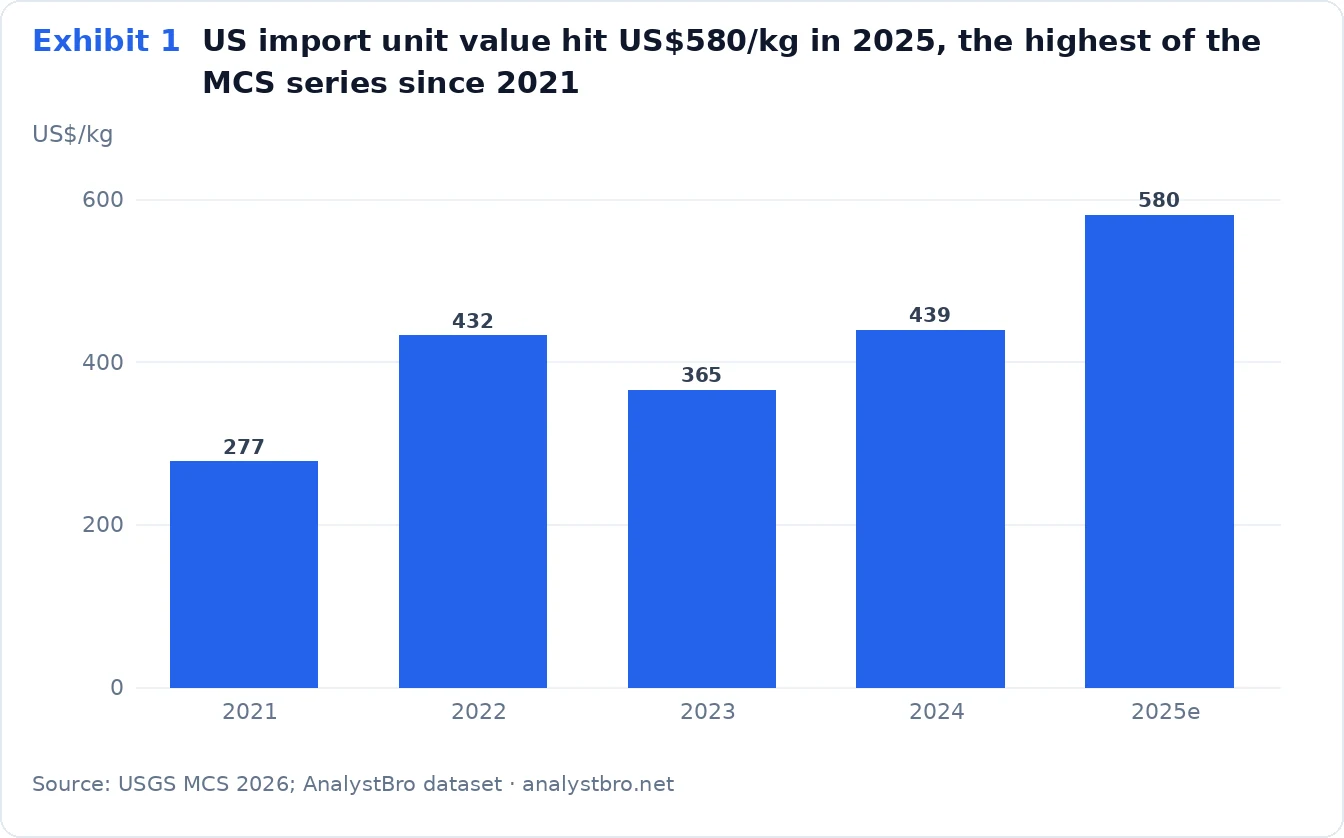
The US import unit value rose from US$439/kg in 2024 to US$580/kg in 2025e, against US$277/kg in 2021.
| 2016 | 2017 | 2018 | 2019 | 2020 | 2021 | 2022 | 2023 | 2024 | 2025e | |
|---|---|---|---|---|---|---|---|---|---|---|
| Nominal (US$/kg) | 690 | 477 | 508 | 573 | 596 | 277 | 432 | 365 | 439 | 580 |
| Real (2025 US$/kg) | 927 | 627 | 652 | 722 | 741 | 329 | 476 | 386 | 451 | 580 |
| Series | DS140 | DS140 | DS140 | DS140 | DS140 | MCS | MCS | MCS | MCS | MCS |
Full history from 1943 is on our gallium price history page.
China produced about 99% of primary gallium in 2025, then restricted exports in three steps
Supply is almost all Chinese. USGS puts 2025 world primary low-purity production at 900,000 kg, of which China produced an estimated 900,000 kg (839,000 kg in 2024). Russia produced 6,000 kg and Japan 3,000 kg [1][2]. The country rows add up to more than the world total because USGS rounds the total. USGS states China's share as 99% [1].
Germany, Hungary and Kazakhstan stopped primary output in 2016, 2015 and 2013. Ukraine most likely stopped in 2022 [1]. Their plants still count as capacity: USGS estimates world capacity of 1,700,000 kg in 2025, with China at 1,600,000 kg [1].
Gallium is a by-product. It is recovered mostly from bauxite during alumina refining, and partly from zinc-processing residues. Bauxite averages about 50 parts per million gallium [1]. A refinery adds a gallium circuit only when the price covers the cost. With China able to supply the world, idle plants elsewhere did not restart.
- 3-Jul-2023: MOFCOM and China's General Administration of Customs issued Announcement No. 23 of 2023. From 1-Aug-2023, listed gallium and germanium items need a dual-use export licence [3][4]. It was a licence system, not a ban [4].
- 3-Dec-2024: MOFCOM Announcement No. 46 of 2024 created a presumption of denial for gallium exports to US end users, in effect a ban on US sales [5].
- November 2025: After the October 2025 Trump–Xi meeting [5], MOFCOM suspended the US ban until 27-Nov-2026 (CSIS gives the document as No. 72) [5][6][7]. Licensing and the ban on dual-use items for US military users stayed in place [6][7].
The controls cut flows hard. CSIS, citing Chinese customs data, says China's exports of unwrought gallium fell 94% in 2025 against 2024 and had not recovered in 2026. China's share of US unwrought gallium imports fell below 5%, from about 38% in 2022 [5].
That explains the US price path. In 2023 licensing was new and most licences were approved at first [5], so the import value fell. From late 2024 US buyers had to source from third countries at prices set outside China, and the 2025 unit value rose. The unit value also mixes grades and origins, so part of each year's move may be mix, not price.
Open question: 27-Nov-2026
The suspension ends on 27-Nov-2026. As of 12-Nov-2026 we found no report that China has extended or ended it. We will update this page when MOFCOM announces a decision.
Integrated circuits took 73% of US gallium use; optoelectronics took 26%
In the US, integrated circuits used 73% of gallium and optoelectronic devices 26% [1]. Gallium arsenide (GaAs) goes into compound semiconductor wafers for ICs, laser diodes, LEDs, photodetectors and solar cells. Gallium nitride (GaN) is used for ICs and optoelectronics [1].
ICs serve defence, high-performance computing and telecoms equipment. Optoelectronics serve aerospace, consumer goods, industry, medicine and telecoms [1]. USGS notes that in many defence uses no effective substitute exists for GaAs and GaN [1]. That is why the US treats the supply as a security issue.
The US has no primary production since 1987. One New York company refines imported low-purity gallium and new scrap to high purity [1]. In 2025 the US imported an estimated US$15 million of gallium metal and US$120 million of GaAs wafers [1].
Gallium is on the EU strategic and critical raw materials lists in the Critical Raw Materials Act [11], and USGS lists it as a critical mineral.
Alcoa's Wagerup plant could add up to 10% of world supply; ERG targets up to 15 t/yr
- Alcoa, Wagerup (Western Australia): Alcoa and the governments of Australia, Japan and the United States announced a final investment decision on 14-Jul-2026 [12][13]. The plant sits at Alcoa's Wagerup alumina refinery. Reports say it could supply up to 10% of world gallium [12][13]. No first-production date was confirmed in what we read.
- ERG, Pavlodar (Kazakhstan): recovery from process solutions at the Pavlodar aluminium plant, up to 15 t/yr at full rate, with a Mitsubishi supply deal. Reported start dates moved between Q3 and Q4 2026 [9][10][14]. We found no confirmation of first output by 12-Nov-2026.
- United States: in September 2025 the Department of Energy offered up to US$6 million for R&D on gallium recovery from alumina or zinc. In November 2025 a US$29.9 million Defense Production Act award went to a Louisiana demonstration plant recovering gallium and scandium from industrial waste [1].
- USGS also lists announced projects in Canada, Greece and the Republic of Korea [1].
CSIS judged that most projects outside China are unlikely to reach full capacity before mid-2027 at best [5].
Recycling helps only a little. There is no recovery from old scrap. New scrap from GaAs device making is reprocessed at one New York plant [1]. Substitution is partial: silicon competes with GaAs in solar cells, silicon CMOS amplifiers in mid-tier handsets, indium phosphide in some infrared lasers, and silicon-germanium in some transistors [1].
Bangladesh's link to gallium is indirect, through imported electronics
Bangladesh does not produce gallium and we found no data showing meaningful imports of gallium metal. The exposure is through finished goods that contain gallium compounds: LED lamps, GaN phone chargers, solar products and telecoms equipment. Gallium is a tiny share of the cost of these items, and we found no source that measures the effect on Bangladesh import prices. The link is real but weak.
The USGS price is a US customs average, not a spot quote
The USGS price is the average customs value of US imports of gallium metal under tariff code 8112.92.1000, from US Census data [1]. It mixes purities and origins, and it reflects contract prices at the border. The 2025 value is an estimate and USGS may revise it [1].
Spot prices from Fastmarkets, Asian Metal or SMM are behind paywalls. They now show two markets: a price inside China and a much higher one outside [5]. A US import average sits between them and lags. Our older line from USGS DS140 uses a different basis; it shows US$625/kg for 2021 against US$277/kg in MCS 2026 [2].
See the gallium overview, the commodity profile and production by country.
FAQ
- What is the gallium price per kg in 2025?
- USGS estimates the average value of US gallium metal imports at US$580/kg in 2025, up from US$439/kg in 2024 [1]. Spot prices outside China were far higher: Fastmarkets reported a record US$1,850/kg in April 2026, as cited by CSIS [5].
- Why is gallium so expensive outside China?
- China makes about 99% of primary gallium [1] and has required export licences since 1-Aug-2023 [3]. Its exports of unwrought gallium fell 94% in 2025 [5], so buyers elsewhere compete for a small supply.
- Who controls gallium supply?
- China. USGS puts China's 2025 primary output at an estimated 900,000 kg of a 900,000 kg rounded world total; Russia (6,000 kg) and Japan (3,000 kg) are the only other producers [1].
- Did China ban gallium exports to the US?
- Yes, from 3-Dec-2024 under MOFCOM Announcement No. 46 [5]. In November 2025 China suspended the ban until 27-Nov-2026, but licences are still required and sales to US military users stay banned [6][7].
- What is gallium used for in chips?
- Gallium arsenide and gallium nitride wafers are used in ICs for defence, computing and telecoms, and in LEDs, laser diodes and solar cells. ICs took 73% of US gallium use [1].
Sources
- USGS, Mineral Commodity Summaries 2026: Gallium · link · accessed 2026-11-12
- AnalystBro USGS annual dataset (gallium series, MCS 2026 and USGS DS140) · link · accessed 2026-11-12
- IEA policy database: MOFCOM/GAC Announcement No. 23 of 2023 on gallium and germanium export control · link · accessed 2026-11-12
- Herbert Smith Freehills Kramer: China releases latest export control measures on gallium and germanium (Aug 2023) · link · accessed 2026-11-12
- CSIS: The US-China trade truce has not solved the gallium problem (11 May 2026) · link · accessed 2026-11-12
- Evertiq: China suspends ban on gallium and germanium exports to the US (10 Nov 2025) · link · accessed 2026-11-12
- Engineering News (Reuters): China halts ban on gallium, germanium, antimony exports to US, but controls remain (10 Nov 2025) · link · accessed 2026-11-12
- Project Blue: ERG to start gallium production in Kazakhstan · link · accessed 2026-11-12
- bne IntelliNews: Kazakhstan set to climb gallium production ranking after ERG, Mitsubishi deal · link · accessed 2026-11-12
- EU Critical Raw Materials Act, Regulation (EU) 2024/1252 · link · accessed 2026-11-12
- Business Wire: Australia, Japan, the United States and Alcoa announce final investment decision for gallium project in Western Australia (14 Jul 2026) · link · accessed 2026-11-12
- Mining.com (Reuters): Alcoa greenlights Australia gallium plant with US, Japan and domestic backing (Jul 2026) · link · accessed 2026-11-12
- Mining.com (Reuters): ERG signs long-term gallium supply deal with Mitsubishi (Dec 2025) · link · accessed 2026-11-12
Revision history
- 12-Nov-2026: Summarised raw event/data tables; added chart findings (this version)
- 12-Nov-2026
Disclaimer
This article is published by AnalystBro for information and education only. It is not investment, financial, legal or tax advice, not an offer or solicitation to buy or sell any security, and not a recommendation. It is based on company filings, official statistics and the sources cited, and was independently reviewed before publishing; it may still contain errors or omissions, and the data and estimates can be out of date. Fair values, forecasts and the model are estimates under stated assumptions, not predictions; past results don't indicate future returns.
AnalystBro, its owners and staff accept no responsibility or liability for any loss or damage arising from the use of, or reliance on, this article, its model or its data. Do your own research and consult a licensed adviser before making investment decisions. Any changes you make in the spreadsheet view stay in your browser and are your own.