Cobalt averaged US$21/lb in 2025, up 25%, after the DRC's export ban
The DRC mined 74% of the world's cobalt, banned exports on 22-Feb-2025, then capped them at 96,600 t a year. USGS data back to 1900 put the move in context.
For information only, not investment advice. AnalystBro accepts no responsibility for decisions made on it. Full disclaimer.
- USGS estimates cobalt averaged US$21/lb in 2025, up 25.2% on 2024 but 31.8% below 2022. →
- The DRC mined 230,000 t of 310,000 t in 2025, banned exports on 22-Feb-2025 and capped them at 96,600 t/yr for 2026–27. →
- EVs used 113 kt of 276 kt cobalt demand in 2025, while cobalt-free LFP passed 55% of EV batteries (IEA). →
- Indonesia's output rose to 44,000 t in 2025 and is the main source of new supply. →
The USGS cobalt price rose 25% to US$21/lb in 2025 after two years of decline
The USGS puts the 2025 average US spot price for cobalt cathode at US$21 per lb (about US$46.30 per kg), an estimate. That is 25.2% above the 2024 average of US$16.77/lb and 22.1% above 2023 (US$17.20/lb) [1][2]. It is still 31.8% below the 2022 average of US$30.78/lb. The LME cash price, which USGS reports as a second line, averaged an estimated US$15/lb in 2025, up from US$11.84/lb in 2024 [1].
Within the year the move was larger. Benchmark's cobalt metal price (EXW Europe) went from US$10.75/lb at the start of 2025 to US$24.75/lb at year-end, up 130%. Its hydroxide price (CIF Asia) went from US$5.90/lb to US$25.25/lb, up 328% [3]. An annual average smooths this out, which is why the USGS figure rose only a quarter.
The USGS series runs back to 1900. In real 2025 dollars the all-time high is 1979, at US$107.59/lb (US$24.18/lb nominal). Other spikes came in 2008 (US$31.03/lb nominal) and 2018 (US$28.94/lb) [2]. In real terms the 2025 price is about one-fifth of the 1979 peak. The causes of pre-1990 spikes are outside the sources we used, so we do not describe them here.
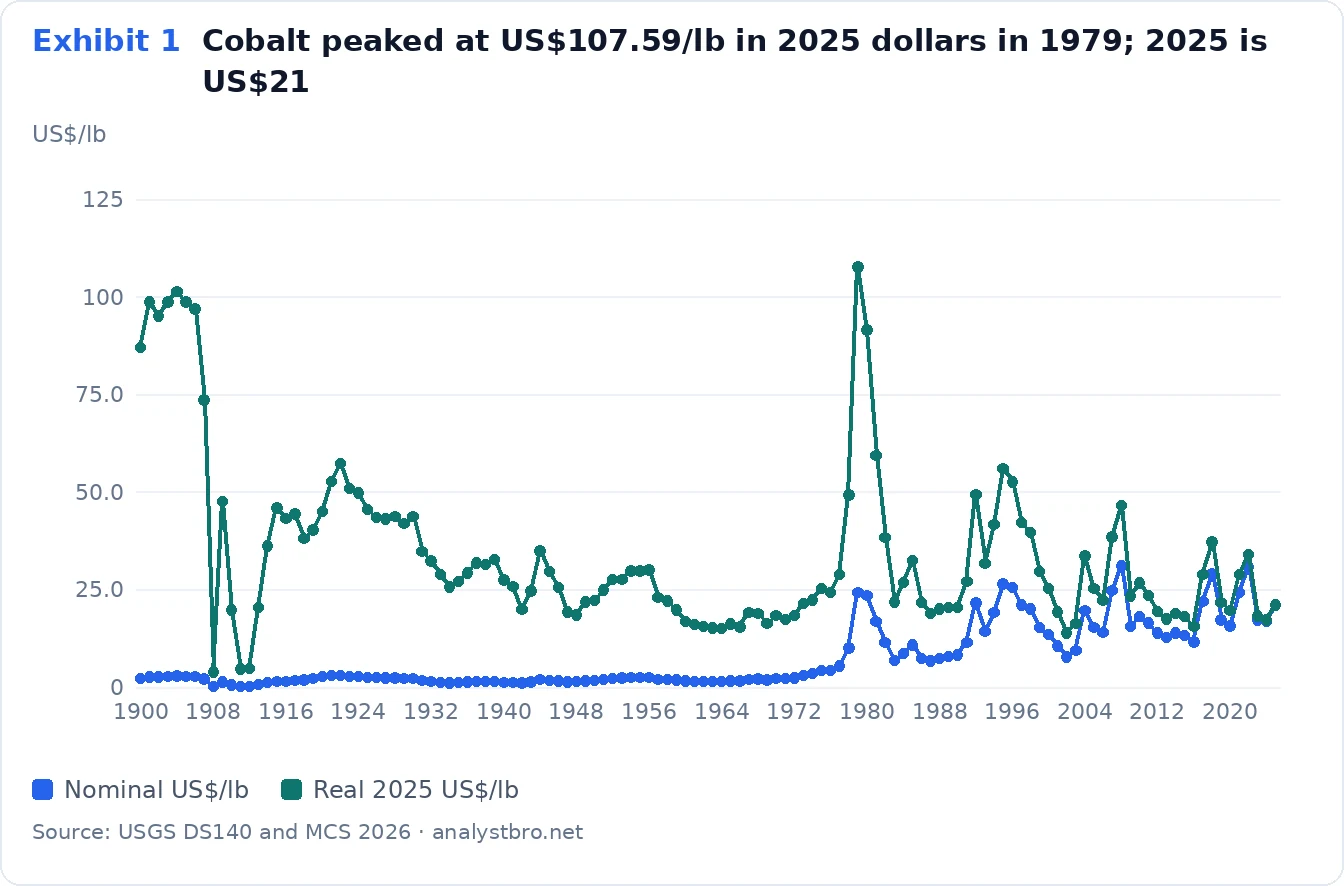
Cobalt averaged US$21/lb in 2025 against US$16.77 in 2024; the real peak was US$107.6/lb in 2025 dollars in 1979.
The DRC mined 74% of the world's 310,000 t in 2025, then stopped exports for almost eight months
USGS estimates world mine output at 310,000 t of cobalt in 2025. The DRC produced 230,000 t (74.2% by our calculation from the table; USGS text gives 73%) and Indonesia 44,000 t (14.2%) [1]. The DRC also holds 6 million t of the world's 12 million t of reserves [1]. The Cobalt Institute says three companies (CMOC, Glencore and ERG) produced over 78% of DRC output, and 72% of DRC mined supply came from Chinese-majority-owned assets in 2025 [3].
| Country | 2024 (t) | 2025 est. (t) | Share 2025 |
|---|---|---|---|
| Congo (Kinshasa) | 226,000 | 230,000 | 74.2% |
| Indonesia | 35,000 | 44,000 | 14.2% |
| Russia | 8,000 | 7,700 | 2.5% |
| Madagascar | 3,100 | 3,900 | 1.3% |
| Australia | 4,780 | 3,700 | 1.2% |
| Philippines | 3,100 | 3,700 | 1.2% |
| Canada | 3,350 | 3,500 | 1.1% |
| Papua New Guinea | 2,630 | 2,800 | 0.9% |
| China | 2,000 | 2,000 | 0.6% |
| Cuba | 3,450 | 2,000 | 0.6% |
| Turkey | 2,200 | 1,900 | 0.6% |
| United States | 200 | 300 | 0.1% |
| Other countries | 7,780 | 9,100 | 2.9% |
| World total (rounded) | 302,000 | 310,000 | 100.0% |
Cobalt is mostly a by-product: of copper in the DRC and of nickel in Indonesia [3]. Output does not respond much to the cobalt price, so supply kept growing while prices fell. By mid-February 2025, hydroxide delivered to China was as low as US$5.60/lb, at or below cost, and the DRC's price-based export tax revenue had fallen [3].
On 22-Feb-2025 the DRC banned all cobalt exports for four months to reverse the price fall. On 21-Jun-2025 it extended the ban for three more months [3]. In September the regulator ARECOMS set a quota system; the ban ran to 15-Oct-2025 and quotas began on 16-Oct-2025 [4].
| Date | Step |
|---|---|
| 22-Feb-2025 | DRC bans all cobalt exports, initially for four months [s3] |
| 21-Jun-2025 | Ban extended by three months [s3] |
| Sep-2025 | ARECOMS announces quotas; ban runs to 15-Oct-2025 (reported 22-Sep) [s4] |
| 16-Oct-2025 | Quotas start: 18,125 t for the rest of 2025 [s4] |
| 2026 and 2027 | Up to 96,600 t a year: 87,000 t to producers + 9,600 t strategic [s1][s3] |
| Apr-2026 | DRC sets up a strategic minerals reserve run by ARECOMS [s3] |
| 30-Jun-2026 | Unused H1-2026 quota forfeited to the strategic allowance (Bloomberg) [s6] |
The quotas allow 18,125 t for the rest of 2025 and up to 96,600 t a year in 2026 and 2027, including 9,600 t for national strategic reserves [1]. That compares with 230,000 t mined in 2025. Allocations follow average output over the prior three years; firms that exported under 100 t in 2024 are excluded (with an exception for the state buyer EGC). Exporters must prepay a 10% royalty on their maximum quota [3]. No cobalt left the country under the 2025 quota because procedures were not ready, so that volume rolled into 2026 [3]. Bloomberg reported that quota unused by 30-Jun-2026 is forfeited to ARECOMS' strategic allowance [6].
The Cobalt Institute calculates that, on mine supply, the 2025 market was still in surplus by 19 kt (7% of demand), down from 48 kt in 2024. But much of that metal was stuck in the DRC, so outside the DRC the market was in deficit [3]. CRU estimates Congolese miners have stockpiled over 200,000 t since 2024, as reported by Bloomberg [6]. China's state stockpile figures are not published.
Artisanal mining is a small part of supply. Benchmark estimated it at 1.8% of global supply at the end of 2024, a low point after weak prices [3]. The DRC is pushing artisanal cobalt through the state buyer EGC to improve traceability. EGC has a monthly quota of 470 t, which caps legal artisanal exports [3]. The quotas therefore also shape how much hand-mined cobalt can reach the market legally. Little quantified data exists on working conditions since the quotas began, so we do not make claims about them.
Batteries take most cobalt: EVs used 113 kt, 39% of 276 kt demand in 2025
Global cobalt demand reached 276 kt in 2025, up 13%, according to the Cobalt Institute. EVs used 113 kt (39%), up 25%. Portable electronics (phones, laptops) used 93 kt. Superalloys for jet engines used 20 kt. Military uses across batteries, magnets and superalloys were about 6.8 kt [3].
The US pattern is different. USGS estimates 51% of US cobalt went to superalloys, 25% to chemicals, 15% to other metal uses and 9% to cemented carbides [1].
The battery shift matters. The IEA says LFP (lithium iron phosphate, no cobalt) was over 55% of EV batteries deployed in 2025, by capacity of new EVs registered, up from nearly 50% in 2024 [5]. The Cobalt Institute puts the share of NCM/NCA cathodes in EVs sold in 2025 at 44%, down 8 points; but on a gigafactory output basis NCM/NCA rose 2 points to 48% [3]. Cobalt-bearing chemistries are also using less cobalt: NMC721, NMC811 and NCA were about 80% of cobalt-containing EV batteries in 2025 [5]. So EV cobalt use still grew in 2025, but more slowly than EV sales.
Indonesia's output rose 26% to 44,000 t and is the main new source
USGS shows Indonesia rising from 35,000 t in 2024 to 44,000 t in 2025 [1]. The Cobalt Institute's figure is 42.5 kt, up 29%, from HPAL nickel plants making mixed hydroxide precipitate [3]. It says Indonesian supply in 2025 exceeded DRC exports, and expects Indonesia to be the largest source of growth over the next five years [3]. It also flags a risk: about 75% of Indonesia's sulphur, used in HPAL, comes from the Middle East [3].
Recycling was about 10% of total supply in 2025, mostly processed in China [3]. In the US, scrap supplied 25% of cobalt use [1]. China refined 79% of the world's 240 kt of refined cobalt in 2025 [3].
Policy is adding new routes. The US–DRC Strategic Partnership in the December 2025 Washington Accords set up a Strategic Asset Reserve with a US right of first offer, and Gécamines' trading venture with Mercuria aims to secure sales rights for up to 40,000 t of cobalt [3]. A US solicitation to buy 7,480 t over five years for the National Defense Stockpile was cancelled before end-2025 [1]. Substitution continues: USGS notes iron-phosphate batteries held significant market share in China [1].
Outside the DRC and Indonesia, mined supply rose 3% to 38 kt in 2025, led by nickel-laterite plants such as Ramu in Papua New Guinea and Goro in New Caledonia [3]. USGS data show smaller producers moved both ways: Madagascar rose from 3,100 t to 3,900 t, while Australia fell from 4,780 t to 3,700 t and Cuba from 3,450 t to 2,000 t [1]. The US mined only 300 t, from the Eagle nickel-copper mine in Michigan, and shipped the concentrate abroad for processing [1]. US net import reliance rose from 73% in 2021 to 79% in 2025 [1]. USGS lists about 1 million t of identified US cobalt resources, mostly in Minnesota, and about 25 million t of identified land-based resources worldwide [1].
Bangladesh's link to cobalt is weak and indirect
Bangladesh does not mine or refine cobalt. Its exposure is through imported phones, laptops and lithium-ion battery packs, whose cells may contain cobalt. We did not find a reliable public figure for the cobalt content of these imports, so we give none, and we do not estimate the price effect on Bangladeshi buyers.
The USGS price is a US cathode annual average; 2025 is an estimate
The main USGS line is the average US spot price of cobalt cathode in US$ per lb [1]. It is a yearly average, not a daily quote. The 2025 value of US$21/lb is marked as an estimate and may be revised [1][2]. To convert to US$ per kg multiply by 2.2046.
USGS world production figures are rounded and estimated, and revisions are common. For example, USGS revised its 2024 output figures for Australia, Canada and Indonesia in this edition [1]. The Cobalt Institute uses its own model and puts 2025 mined supply at 270 kt rather than 310,000 t, so shares differ slightly between sources [1][3].
The LME cash line is lower (US$15/lb est. in 2025) because it reflects a different contract and market [1]. Trade press prices differ again: hydroxide is an intermediate priced on a payable basis and moved more than metal in 2025, briefly trading above metal [3]. Daily prices from Fastmarkets, Benchmark or SMM are paid services. Pre-2021 values come from USGS Data Series 140, spliced to the MCS series [2]. See the price history, production by country, profile and cobalt overview pages.
FAQ
- What is the cobalt price per kg in 2025?
- USGS estimates the 2025 US spot cathode average at US$21/lb, about US$46.30/kg, up from US$16.77/lb in 2024 [1].
- Why did the DRC ban cobalt exports?
- Prices had fallen to or below cost (hydroxide as low as US$5.60/lb in February 2025) and price-based tax revenue had dropped. The ban started on 22-Feb-2025 [3].
- How do the DRC cobalt quotas work?
- From 16-Oct-2025, ARECOMS allows 18,125 t for late 2025 and up to 96,600 t a year in 2026–27, including 9,600 t strategic, allocated by past output [1][3][4].
- Who controls cobalt supply?
- The DRC mined 74% of world cobalt in 2025 and Indonesia 14% [1]. China refined 79% of refined cobalt, and Chinese-majority assets supplied 72% of DRC output [3].
- Does LFP mean the end of cobalt demand?
- No. LFP passed 55% of EV batteries in 2025 [5], but EV cobalt demand still rose 25% to 113 kt because battery output grew [3].
Sources
- USGS Mineral Commodity Summaries 2026: Cobalt · link · accessed 2026-11-12
- USGS annual cobalt price series 1900–2025 (DS140 + MCS), as held in AnalystBro usgs_annual.json · link · accessed 2026-11-12
- Cobalt Institute, Cobalt Market Report 2025 (May 2026, prepared with Benchmark) · link · accessed 2026-11-12
- Benchmark Mineral Intelligence: DRC to lift cobalt export ban and impose quotas through 2027 (22-Sep-2025) · link · accessed 2026-11-12
- IEA Global EV Outlook 2026: Electric vehicle batteries · link · accessed 2026-11-12
- Miningmx (citing Bloomberg): Congo to claw back unused cobalt quotas (30-Jun-2026) · link · accessed 2026-11-12
Revision history
- 12-Nov-2026: Summarised raw event/data tables; added chart findings (this version)
- 12-Nov-2026
Disclaimer
This article is published by AnalystBro for information and education only. It is not investment, financial, legal or tax advice, not an offer or solicitation to buy or sell any security, and not a recommendation. It is based on company filings, official statistics and the sources cited, and was independently reviewed before publishing; it may still contain errors or omissions, and the data and estimates can be out of date. Fair values, forecasts and the model are estimates under stated assumptions, not predictions; past results don't indicate future returns.
AnalystBro, its owners and staff accept no responsibility or liability for any loss or damage arising from the use of, or reliance on, this article, its model or its data. Do your own research and consult a licensed adviser before making investment decisions. Any changes you make in the spreadsheet view stay in your browser and are your own.