Antimony averaged US$25/lb in 2025, 4.7 times 2021, after China's export curbs
USGS data show the antimony price jumped after China's September 2024 licence rule and December 2024 US ban. Here is the supply, demand and policy story behind the numbers.
For information only, not investment advice. AnalystBro accepts no responsibility for decisions made on it. Full disclaimer.
- USGS puts the 2025 antimony average at US$25.0/lb, up 144% on 2024 and 4.7x 2021. →
- China, Russia and Tajikistan mined 85.5% of the world's 110,000 t in 2025. →
- China's licence rule (15-Sep-2024) and US ban (3-Dec-2024) drove the price doubling; the US ban is suspended until 27-Nov-2026. →
- US net import reliance rose to 91% in 2025; a US$80m defence award backs a new Idaho mine. →
The USGS average antimony price reached US$25.0/lb in 2025, 4.7 times the 2021 level
The US Geological Survey (USGS) puts the 2025 average antimony metal price at US$25.0 per pound (about US$55 per kg). That is an estimate, because the year was not complete when the agency published [1]. In 2021 the average was US$5.31/lb. The 2025 figure is 4.7 times that level [2].
Most of the jump came in two steps. The average rose from US$5.49/lb in 2023 to US$10.24/lb in 2024, an increase of 87%. It then rose 144% to US$25.0/lb in 2025 [2]. After inflation, the 2025 price is about 4.0 times the 2021 level (US$6.31/lb in 2025 dollars) [2].
USGS also gives monthly detail. The average monthly price nearly doubled from US$9.80/lb in August 2024 to US$18.10/lb in December 2024. It rose another 52% to US$27.50/lb by June 2025, then eased to US$20.30/lb in November 2025 [1]. On the spot side, Fastmarkets reported that its assessment hit a record US$59,750 per tonne on 4-Jul-2025, and that prices fell after mid-2025 [8].
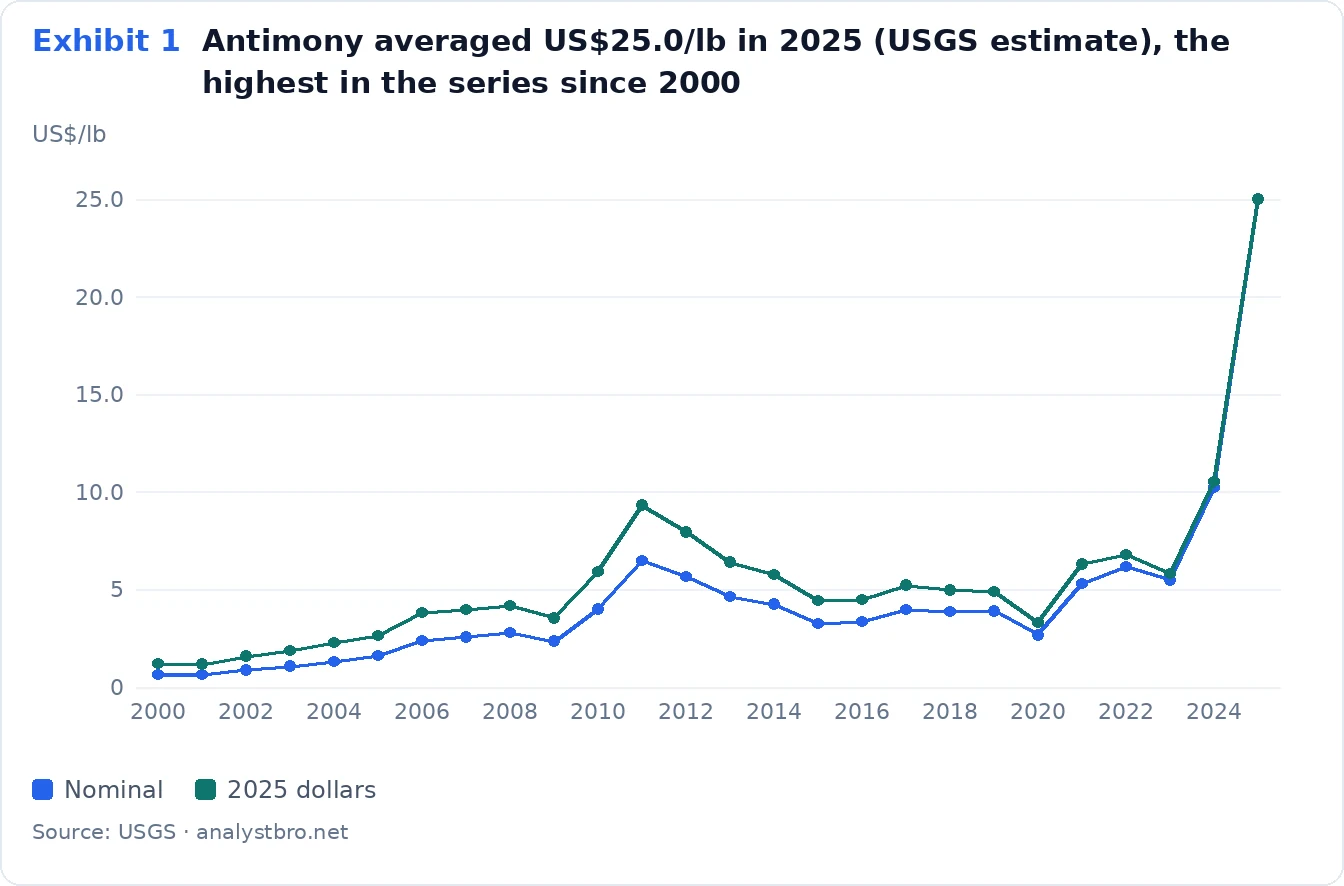
Antimony averaged US$25/lb in 2025, against US$10.24 in 2024 and US$5.31 in 2021; in 2025 dollars the 2000 price was US$1.22.
| Year | US$/lb (nominal) | US$/lb (2025$) | US$/kg (nominal) |
|---|---|---|---|
| 2014 | 4.25 | 5.78 | 9.40 |
| 2015 | 3.27 | 4.45 | 7.20 |
| 2016 | 3.35 | 4.50 | 7.40 |
| 2017 | 3.98 | 5.23 | 8.80 |
| 2018 | 3.88 | 4.98 | 8.60 |
| 2019 | 3.90 | 4.91 | 8.60 |
| 2020 | 2.67 | 3.32 | 5.89 |
| 2021 | 5.31 | 6.31 | 11.70 |
| 2022 | 6.18 | 6.80 | 13.60 |
| 2023 | 5.49 | 5.81 | 12.10 |
| 2024 | 10.24 | 10.52 | 22.60 |
| 2025 (est.) | 25.00 | 25.00 | 55.10 |
Full annual history back to 1900 is on our antimony price history page.
Three countries mined 85% of world antimony in 2025, and China restricted its exports from 15-Sep-2024
Mine supply is concentrated. USGS estimates 2025 world mine output at 110,000 t, down from 119,000 t in 2024. China mined 40,000 t (36.4%), Russia 32,000 t (29.1%) and Tajikistan 22,000 t (20.0%) [1]. Russia's output fell from 40,000 t in 2024 [1]. Country rows are on our production by country page.
| Country | 2024 (t) | 2025 est. (t) | Share of 2025 world (%) |
|---|---|---|---|
| China | 40,000.0 | 40,000.0 | 36.4 |
| Russia | 40,000.0 | 32,000.0 | 29.1 |
| Tajikistan | 22,000.0 | 22,000.0 | 20.0 |
| Bolivia | 5,300.0 | 5,000.0 | 4.5 |
| Burma | 4,500.0 | 4,500.0 | 4.1 |
| Turkey | 3,000.0 | 3,000.0 | 2.7 |
| World total | 119,000.0 | 110,000.0 | 100.0 |
Mining share understates China's role in processing. Reuters reported that China is the largest supplier of refined antimony but a net importer of concentrates, which it imports from Thailand, Myanmar and Russia [3]. A ban on Chinese exports therefore hits the refined metal and oxide that factories use, not only ore.
Policy did the rest. On 15-Aug-2024 China's Ministry of Commerce (MOFCOM) announced export controls on antimony on national-security grounds [3]. The rules (Announcement No. 33 of 2024) took effect on 15-Sep-2024 [4]. They cover antimony ore and concentrate, metal, antimony trioxide and some compounds, and require a dual-use export licence. They also bar export of gold-antimony smelting and separation technology without approval [5].
On 3-Dec-2024 MOFCOM Announcement No. 46 went further: it banned exports of gallium, germanium and antimony to the United States [10]. USGS links the 2024 price doubling to these two steps [1]. Europe was also hit. Reuters reported in March 2025 that Chinese antimony shipments to the EU had stopped from October 2024 under the licence system [9].
Status in November 2026
- On 9-Nov-2025 MOFCOM suspended the US-specific ban (clause 2 of Announcement No. 46) until 27-Nov-2026 [6][7].
- The licence regime from Announcement No. 33 stayed in place, and exports to US military end users remain banned [6].
- Fastmarkets reported that antimony exports rose in November 2025 after the suspension [8]. What happens after 27-Nov-2026 had not been announced when this article was written.
US net import reliance on antimony rose from 85% in 2021 to 91% in 2025
The United States is the clearest case of a market cut off by the December 2024 ban. USGS estimates US net import reliance at 91% of apparent consumption in 2025, up from 85% in 2021, 81% in 2022 and 2023, and 86% in 2024 [1]. Net import reliance means the share of use that is not met by domestic mine, smelter and scrap output.
Before the ban, China was the main source of what the US imported. For 2021 to 2024, USGS lists China as the source of 66% of US antimony oxide imports and 55% of total metal and oxide imports. Belgium supplied 16% of oxide and 12% of total metal and oxide. Thailand supplied 8% of the total and India 6% [1]. Ore and concentrate imports came mostly from Mexico (86%) and Italy (9%) [1].
The import mix in 2025 moved toward oxide. USGS estimates oxide imports at 39,000 t, up from 24,000 t in 2024. Imports of unwrought metal and powder fell from 4,920 t to 4,500 t. Ore and concentrate imports rose from 430 t to 600 t, feeding the Montana smelter [1]. US primary smelter output was estimated at 700 t in 2025, against 588 t in 2024. Secondary output from scrap was about 3,500 t [1].
All US tariff lines for antimony (HS 2617.10 ore, 2825.80 oxide, 8110.10 unwrought metal, 8110.20 scrap and 8110.90 articles) carried a free normal-trade-relations rate at 31-Dec-2025 [1]. So the cost shock came from supply and policy abroad, not from US duties.
Europe faced the same squeeze through licences rather than an outright ban. Reuters reported that EU imports of Chinese antimony stopped from October 2024, after the licence regime started [9]. The EU already lists antimony among its critical raw materials. Fastmarkets wrote in January 2026 that it expected the gap between Chinese and international prices to narrow as Chinese exports resumed [8]; that is the agency's view, not ours.
Flame retardants and metal products took 49% of US antimony use; lead and ammunition took 40%
USGS splits US use into three groups. Metal products, including flame retardants, took 49%. Antimonial lead and ammunition took 40%. Nonmetal products, such as ceramics, glass and rubber, took 11% [1].
- Flame retardants. Antimony trioxide is added with halogen compounds to plastics, textiles and cable insulation. USGS lists organic compounds and hydrated aluminium oxide as substitutes here [1].
- Lead-acid batteries. Antimonial lead hardens battery grids. Secondary antimony in the US comes from spent lead-acid batteries and goes back into the same industry [1].
- Defence. Reuters lists ammunition, infrared missiles, nuclear weapons and night-vision goggles among military uses [3].
- Solar. Reuters reported that demand from the photovoltaic sector helped push prices to records in 2024, and that antimony improves solar cell performance [3]. The usual route is solar glass, where antimony is used as a fining agent; we found no free, sourced tonnage figure for this use.
US apparent consumption, as estimated by USGS, rose from 28,600 t in 2024 to 45,000 t in 2025. Oxide imports rose from 24,000 t to 39,000 t [1]. Part of that is likely stockpiling ahead of supply risk, but USGS does not say so, and we do not claim it.
A US$80 million US defence award backs an Idaho mine; Montana mining restarted in 2025
USGS reports that in October 2025 a mining company in Idaho broke ground on an antimony mine. It was conditionally awarded US$80 million by the US Department of War to rebuild a domestic source [1]. USGS cites the company as reporting total proven and probable reserves of 14 million tons with an ore cutoff grade of 0.42% contained antimony [1]. In November 2025 another company said mining had started at the Stibnite Hill Mine in Montana [1]. A Montana smelter already makes metal and oxide from imported feed [1].
Reserves are wider than output. USGS lists China (830,000 t), Russia (350,000 t), Bolivia (310,000 t), Kyrgyzstan (260,000 t) and Burma (140,000 t), with the world total above 2 million t [1]. US reserves are 60,000 t [1].
Recycling is limited to one loop. Secondary antimony from battery scrap supplied 12% of US apparent consumption in 2025, worth about US$190 million [1]. Substitution is possible in some uses: calcium, copper, selenium, sulphur and tin alloys for battery grids, and chromium, tin, titanium, zinc and zirconium compounds in enamels and pigments [1]. The US Defense Logistics Agency listed 700 t of antimony as potential stockpile acquisitions for fiscal year 2025 [1].
Bangladesh's link is indirect: imported batteries, plastics and solar panels carry the antimony cost
Bangladesh does not mine or refine antimony, and we found no reliable public data on its direct imports of antimony metal (HS 8110) or oxides (HS 2825.80). The exposure is indirect. Local lead-acid battery makers may use antimonial lead or imported grid alloys. Flame-retarded plastics and cables, and imported solar panels and glass, carry antimony inside them. Higher antimony prices raise the cost of those inputs, but we have no sourced figure for how much, so we do not estimate it.
For readers in Bangladesh, the practical signal is cost pressure on battery, cable and plastics makers that import alloys or compounds abroad, and on solar projects that import glass and panels. Users can check their own supplier contracts against the price path above. UN Comtrade (HS 8110 and 2825.80) is the place to check any direct trade; we did not quote it here.
In short, Bangladesh is a price taker at the end of the chain. The antimony story matters to it through prices of finished goods, not through any domestic supply or policy decision.
The USGS figure is a yearly Argus CIF metal average in US$/lb; other quotes run differently
Our series uses the USGS line "Price, metal, average, dollars per pound" [1][2]. It is a yearly average of the Argus Media price for antimony metal (minimum 99.65%, cost, insurance and freight) [1]. It smooths monthly swings, so it peaked at US$25.0/lb for 2025 even though the monthly average reached US$27.50/lb in June 2025 [1].
News reports often quote other prices: Rotterdam warehouse metal in US dollars per tonne (Fastmarkets), or Chinese domestic prices in yuan per tonne. These differ by location, by grade and by whether the metal can legally leave China. Fastmarkets reported a gap between Chinese and international prices during the controls [8]. To compare, 1 lb = 0.4536 kg; US$25.0/lb equals about US$55,100 per tonne.
Two caveats apply. The 2025 value is a USGS estimate and may be revised. 2020 comes from the USGS 2023 summary, because the two main datasets do not cover it [2]. See the antimony profile and the antimony market page.
FAQ
- What was the antimony price per kg in 2025?
- USGS estimates the 2025 average metal price at US$25.0 per pound, about US$55 per kg. In 2021 it was US$5.31/lb (about US$11.7/kg) [1].
- Why is antimony so expensive?
- Mining is concentrated in China, Russia and Tajikistan (85% of 2025 output), and China, the main refiner, put exports under licence from 15-Sep-2024 and banned US-bound exports on 3-Dec-2024 [1][4][10].
- Who controls antimony supply?
- China mined 40,000 t of 110,000 t in 2025 (36%) and is the largest refined supplier; Russia mined 32,000 t and Tajikistan 22,000 t [1][3].
- Is China's antimony export ban to the US still in force?
- MOFCOM suspended the US-specific ban from 9-Nov-2025 to 27-Nov-2026. Export licences are still required, and sales to US military users stay banned [6][7].
- What is antimony used for?
- In the US: flame retardants and metal products 49%, antimonial lead and ammunition 40%, ceramics, glass and rubber 11% [1]. Solar equipment is a growing use [3].
Sources
- USGS Mineral Commodity Summaries 2026: Antimony · link · accessed 2026-11-12
- USGS annual antimony price series (Historical Statistics DS140 + MCS), as held in AnalystBro usgs_annual.json · link · accessed 2026-11-12
- Reuters via Kitco: China to limit antimony exports in latest critical mineral curbs (15-Aug-2024) · link · accessed 2026-11-12
- Global Trade Alert: China, export control measures for antimony (MOFCOM/GAC Announcement 2024 No. 33) · link · accessed 2026-11-12
- Asian Metal: China to impose export controls on antimony from Sep 15 · link · accessed 2026-11-12
- Mining Weekly (Reuters): China halts ban on gallium, germanium, antimony exports to US but controls remain (10-Nov-2025) · link · accessed 2026-11-12
- Global Trade Alert: China temporary suspension of stricter export controls on certain dual-use items to the US (Nov-2025) · link · accessed 2026-11-12
- Fastmarkets insight: Antimony 2026, ample supply (7-Jan-2026) · link · accessed 2026-11-12
- Mining Weekly (Reuters): China export controls freeze antimony shipments to EU from October (20-Mar-2025) · link · accessed 2026-11-12
- S&P Global Market Intelligence: China responds to US restrictions with export ban on select critical minerals (Dec-2024) · link · accessed 2026-11-12
Revision history
- 12-Nov-2026: Summarised raw event/data tables; added chart findings (this version)
- 12-Nov-2026
Disclaimer
This article is published by AnalystBro for information and education only. It is not investment, financial, legal or tax advice, not an offer or solicitation to buy or sell any security, and not a recommendation. It is based on company filings, official statistics and the sources cited, and was independently reviewed before publishing; it may still contain errors or omissions, and the data and estimates can be out of date. Fair values, forecasts and the model are estimates under stated assumptions, not predictions; past results don't indicate future returns.
AnalystBro, its owners and staff accept no responsibility or liability for any loss or damage arising from the use of, or reliance on, this article, its model or its data. Do your own research and consult a licensed adviser before making investment decisions. Any changes you make in the spreadsheet view stay in your browser and are your own.