Lead profile
USGS annual data · updated 2026-11-12 · next USGS release Jan–Feb 2027
Lead is a heavy, soft, corrosion-resistant metal mined mostly from galena ore, often with zinc and silver.
What is lead?
Lead is a heavy, soft, corrosion-resistant metal mined mostly from galena ore, often with zinc and silver. Most lead today comes from recycling used batteries.
On the US 2025 critical minerals list.
What is lead used for?
- Lead-acid batteries
- Cable sheathing
- Radiation shielding
- Ammunition
- Alloys and solder
- Roofing and weights
Who produces lead?
In 2025 (USGS estimate) China produced 1,900 thousand metric tons, about 42% of world mine production of 4,500 thousand metric tons. Next came Australia (11%), Peru (6%). The USGS estimates world lead mine production at about 4.5 million metric tons in 2025, down from 4.6 million in 2024. Reported reserves are largest in Australia (34 million tons), China (22 million) and Russia (8.9 million). Secondary lead from recycled batteries makes up a large share of refined supply.
Supply risks
Lead is toxic, and informal battery recycling causes serious health and environmental damage. Long-run demand depends on lead-acid batteries, which face competition from lithium-ion.
Lead price history in brief
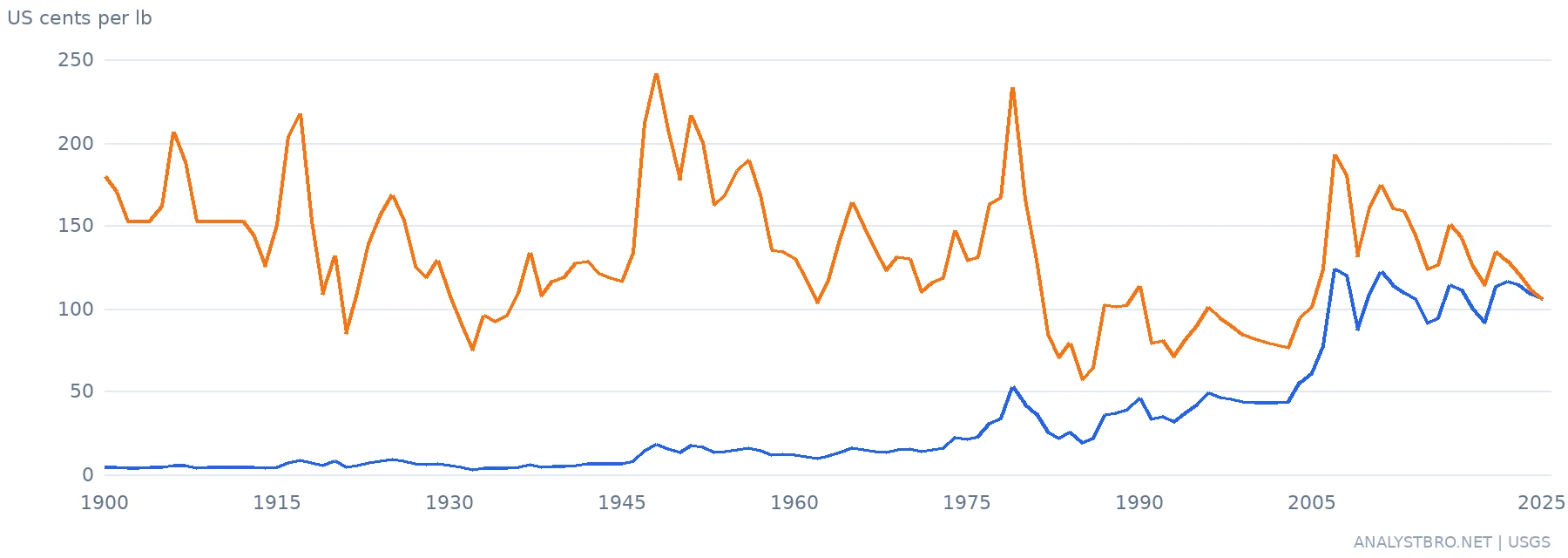
The North American lead price is estimated at 106 cents per pound in 2025. The nominal high was about 124 cents in 2007, while in 2025 dollars the peak was about 241 cents in 1948. The 1900 price of about 4.5 cents equals about 179 cents today, so the real price is about 41% lower.
Why it matters for Bangladesh
Bangladesh uses lead mainly in lead-acid batteries for vehicles, easy-bikes and solar systems, and a large part is recycled locally. Battery makers' costs follow lead prices, though the main producers are not listed on the DSE.
Frequently asked questions
What is the lead price per pound?
The USGS estimates the North American lead price at 106 cents per pound in 2025.
Which country has the largest lead reserves?
Australia, with 34 million tons of reported reserves in the USGS data, followed by China at 22 million tons.
Lead price history
Lead was about 4.5 cents per pound in 1900, about 124 cents in 2007, and an estimated 106 cents in 2025.
Why does lead matter for Bangladesh?
Lead is the main input in lead-acid batteries widely used in Bangladeshi vehicles, easy-bikes and solar systems.
Related commodities
- Source: U.S. Geological Survey, Mineral Commodity Summaries 2026 data release (doi:10.5066/P1WKQ63T) and Data Series 140, Historical Statistics for Mineral and Material Commodities (USGS). Public domain. 2025 values are USGS estimates (marked e).
- Facts only, not investment advice.