Cerium profile
USGS annual data · updated 2026-11-12 · next USGS release Jan–Feb 2027
Cerium is the most abundant rare earth element.
What is cerium?
Cerium is the most abundant rare earth element. It is produced from bastnäsite and monazite ores together with lanthanum and the magnet rare earths, and is sold as cerium oxide or carbonate.
On the US 2025 critical minerals list.
What is cerium used for?
- Glass and semiconductor polishing powders
- Automotive catalytic converters
- Glass decolorizing and UV-blocking
- Oil refinery catalysts
- Mischmetal and lighter flints
- Steel and aluminium alloy additives
Who produces cerium?
It comes out of all light rare earth mining, led by China, with other output from the United States, Australia and Myanmar.
Supply risks
Cerium is normally oversupplied because every tonne of rare earth ore contains a large share of it. The main supply risk is that most rare earth separation takes place in China.
Cerium price history in brief
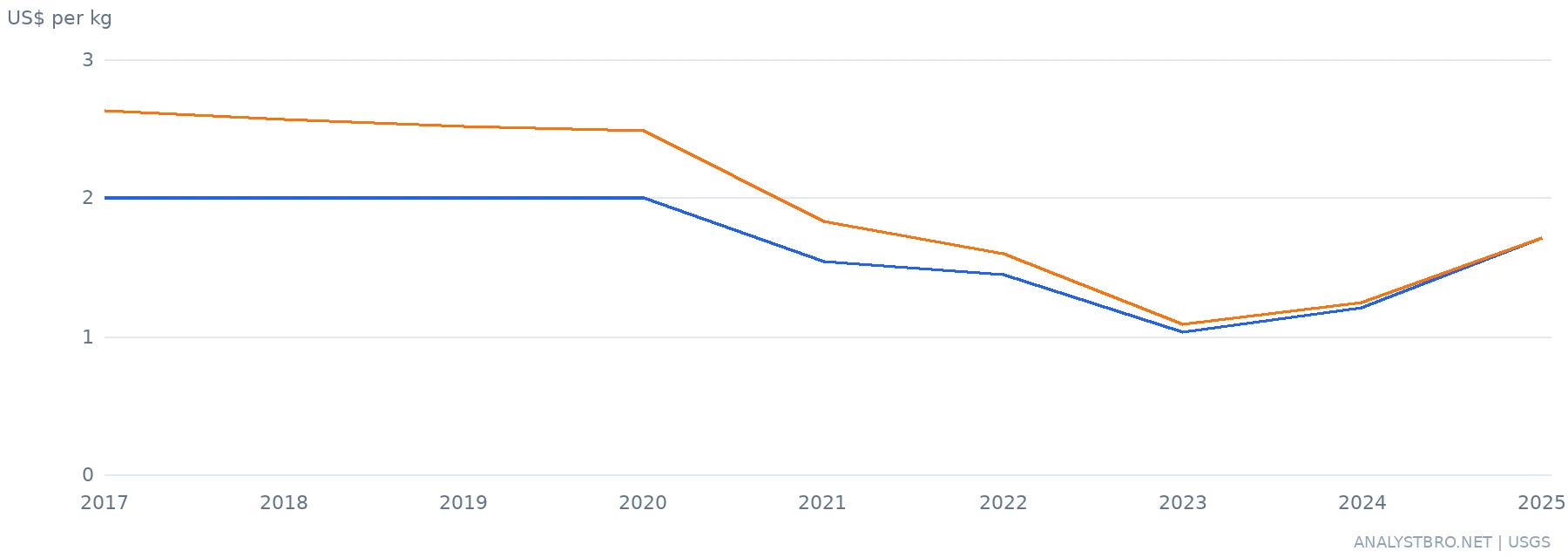
The USGS price for cerium oxide (99.5% minimum) was $1.54 per kg in 2021 and dipped to $1.21 in 2024. The 2025 USGS estimate is $1.71 per kg, the highest in the series and about 11% above 2021.
Why it matters for Bangladesh
Bangladesh has no cerium production; Cerium reaches it inside imported vehicles, glass and electronics.
Frequently asked questions
What is the price of cerium per kg?
The USGS estimate for 2025 is $1.71 per kg of cerium oxide (99.5% minimum).
Is cerium a critical mineral?
Yes. Cerium is on the U.S. Critical minerals list.
What is cerium used for?
Polishing glass and silicon wafers, catalytic converters, and glass additives.
Is cerium the most common rare earth?
Yes. Cerium is the most abundant rare earth element in the Earth's crust.
Related commodities
Lanthanum · Rare earths · Neodymium · Praseodymium
- Source: U.S. Geological Survey, Mineral Commodity Summaries 2026 data release (doi:10.5066/P1WKQ63T) and Data Series 140, Historical Statistics for Mineral and Material Commodities (USGS). Public domain. 2025 values are USGS estimates (marked e).
- Facts only, not investment advice.